Aircraft Vacuum Toilets: Keeping the Skies Clean
Why Aircraft Vacuum Toilets Are Essential for Modern Aviation
The vacuum toilet system in aircraft is an ingenious engineering solution that uses differential pressure to manage waste at 40,000 feet. Here’s how it works:
Key Features:
- Vacuum Generation: Uses cabin pressure difference or electric pumps to create suction
- Water Efficiency: Flushes with just 0.5 gallons vs. 1.6-5 gallons for home toilets
- Weight Savings: 50% lighter than traditional systems, saving fuel costs
- Odor Control: Sealed system prevents waste odors from entering the cabin
- Compact Design: 2-inch pipes vs. 4-inch gravity-fed systems
As aviation historian Daniel Bubb notes, “It’s like your vacuum cleaner – it sucks,” but this simple principle solved complex challenges that made modern air travel possible. The distinctive “whoosh” is the sound of sophisticated engineering that replaced heavy, unreliable chemical toilets with lightweight, efficient systems.
Why Traditional Toilets Don’t Work in Aircraft:
- Moving vehicles would splash water from bowls
- Gravity-fed systems require heavy water tanks
- Large plumbing pipes add weight and installation complexity
- Siphon mechanisms fail during turbulence and altitude changes
I’m Michelle Amelse, VP of Marketing and Customer Success at Satellite Industries. With over 26 years in the portable sanitation industry, I’ve worked with advanced vacuum toilet system in aircraft technologies and their ground-based applications, developing sanitation solutions that bring similar engineering principles to terrestrial environments.
The Science of the Whoosh: How Aircraft Vacuum Toilets Work
The distinctive “whoosh” from an aircraft lavatory is the signature of clever engineering. Flushing at 35,000 feet is a fascinating display of physics in action.
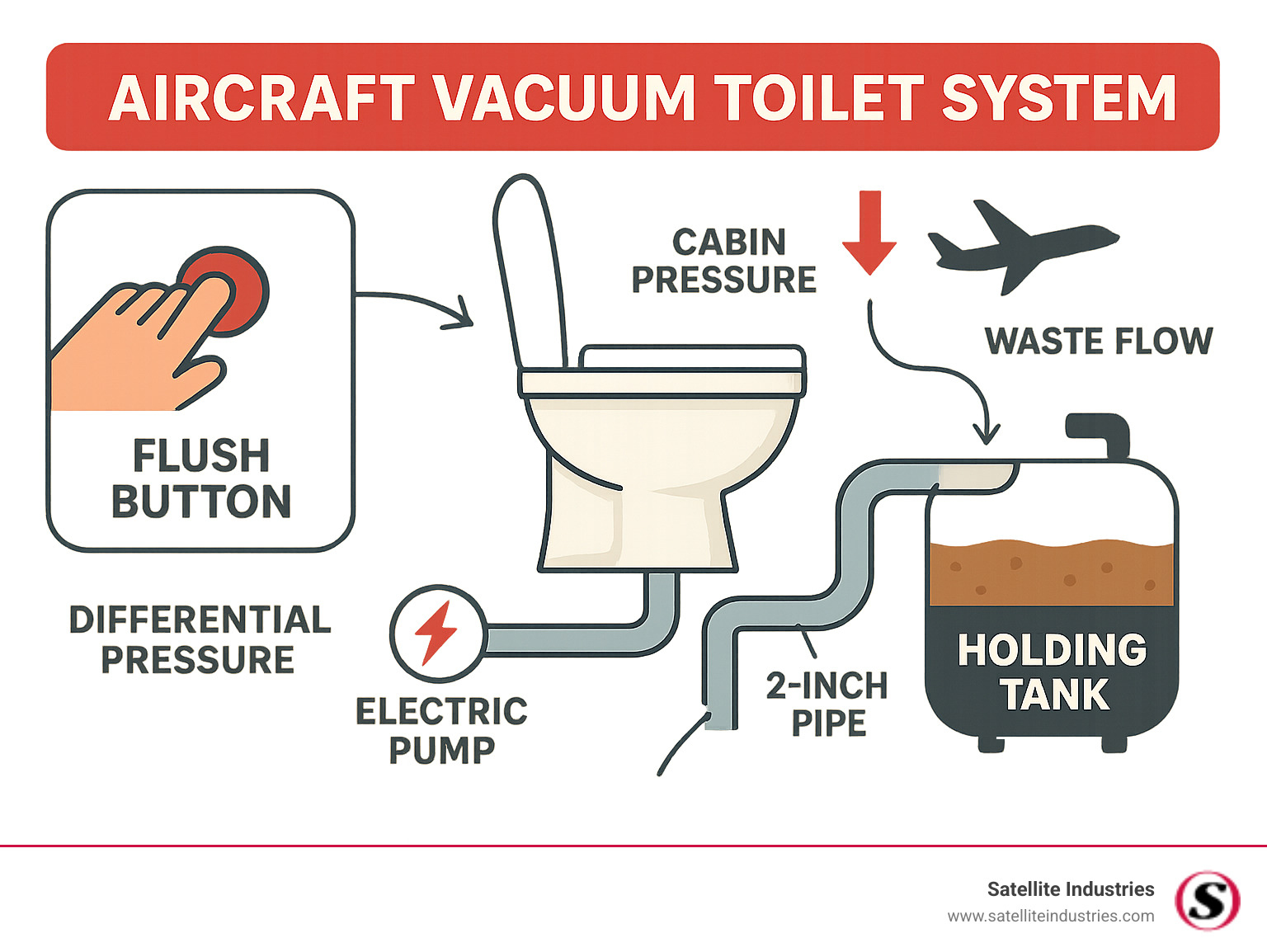
The magic behind the vacuum toilet system in aircraft lies in differential pressure. At cruising altitude, the pressurized cabin has much higher air pressure than the thin air outside. This pressure difference powers the system.
When you press the flush button, a valve opens, connecting the toilet bowl to the lower pressure outside. The higher pressure in the cabin pushes waste through the system at high speed, creating a powerful suction effect.
The toilet bowls are coated with Teflon or similar non-stick materials, so waste slides away easily. This smart design means the system only needs about half a gallon of water per flush, compared to the 1.6 to 5 gallons your home toilet uses. That’s a huge difference when flying a 200-ton aircraft thousands of miles.
The Role of Altitude in System Operation
Altitude changes how the system operates, and the vacuum toilet system in aircraft adapts automatically.
When cruising above 16,000 feet, the pressure difference between the cabin and the outside air creates a natural vacuum. No extra power is needed; the physics of high-altitude flight does all the work, pulling waste into sealed holding tanks.
During takeoff, landing, or at lower altitudes, the electric vacuum generator kicks in. These pumps switch on automatically when the natural pressure difference isn’t strong enough. The aircraft’s control systems monitor altitude and pressure, seamlessly switching between natural vacuum and electric assistance to ensure consistent performance.
The Flush Cycle Explained
Pressing the flush button triggers a precise sequence managed by the Flush Control Unit (FCU), the brain of the operation.
Pressing the flush button signals the FCU. First, it opens the rinse valve, releasing 6 to 8 ounces of water to moisten the bowl. Almost simultaneously, the main flush valve opens to connect the toilet bowl to the vacuum line.
The powerful vacuum then rapidly sucks waste and air through small 2-inch diameter pipes into the waste holding tank. This creates the “whoosh” sound as waste travels at high speed through the plumbing.
After 3 to 4 seconds, both valves close, sealing the system. The FCU monitors the process, ensuring the system is ready for the next use.
The whole cycle is designed for speed, cleanliness, and efficiency—a perfect example of smart engineering solving complex problems in challenging environments.
Gravity-Fed vs. Vacuum: Why Airplanes Need Specialized Systems
Imagine using a home toilet during severe turbulence—water sloshing, gravity failing as the plane banks, and a hygiene nightmare. This illustrates why gravity-fed toilets don’t work in aircraft, making the vacuum toilet system in aircraft essential.
The fundamental problem is physics and practicality. Traditional toilets need large, heavy water tanks for flushing power. On an aircraft where every pound matters, this weight penalty impacts fuel efficiency and operational costs, making it uneconomical to fly heavy water tanks.
Beyond weight, the siphon mechanism in home toilets relies on consistent gravity. During takeoff, landing, or turbulence, this mechanism would fail, and the water-filled bowl would splash, creating unsanitary conditions.
Installation is another hurdle. Gravity-fed systems need large, sloped 4-inch pipes. In a cramped aircraft, this limits lavatory placement and cabin optimization, forcing designers to sacrifice passenger space.
Comparing Vacuum Toilets and Traditional Gravity-Fed Toilets
The differences between these two systems are clear when examined side by side:
FeatureVacuum Toilet SystemGravity-Fed Toilet SystemWeightLightweight composites, less waterHeavy porcelain, large water tankWater Usage~0.5 gallons (2 liters) per flush1.6 – 5 gallons (6-19 liters) per flushMechanismDifferential pressure / Vacuum pumpGravity and SiphonPipe Size~2-inch diameter~4-inch diameterInstallationFlexible, can flush upwardsRestricted by gravity, requires downward slopeOdor ControlSuperior, sealed systemModerate, relies on water trap
Key Advantages for Aviation
Reduced aircraft weight is the primary advantage. These systems weigh 50% less than traditional alternatives and use minimal water, creating a domino effect of improvements.
Significant fuel savings flow directly from the reduced weight. Multiplied across thousands of flights, the fuel cost reductions are substantial, allowing airlines to operate more efficiently and reduce their environmental footprint.
Increased passenger capacity is possible because smaller 2-inch pipes and flexible installation free up cabin space. Designers can optimize layouts, potentially adding more seats or improving comfort areas.
Improved hygiene results from the sealed system and powerful suction. Unlike traditional systems, vacuum systems create an airtight seal that prevents unpleasant smells from entering the cabin, improving passenger comfort.
Reduced corrosion risk eliminates problems from older chemical toilets that used harsh blue fluids. Minimal fluid usage and quick waste removal protect aircraft components, lowering maintenance costs and improving safety.
Design freedom for cabin layouts gives engineers flexibility in lavatory placement. Since vacuum systems can flush in any direction, designers can position lavatories for optimal passenger flow and space.
These advantages show why vacuum technology is necessary for the safe, efficient, and comfortable air travel we expect today.
Anatomy of the Aircraft Vacuum Toilet System and Its Maintenance
The vacuum toilet system in aircraft is an engineering masterpiece, designed to operate flawlessly in demanding environments. At Satellite Industries, we appreciate this excellence as we apply similar principles to our ground-based vacuum technology.
The reliability is remarkable, with some systems logging nearly 30 million flight hours with failure rates four times better than older systems. This performance requires sophisticated design and meticulous maintenance.
Key Components of the System
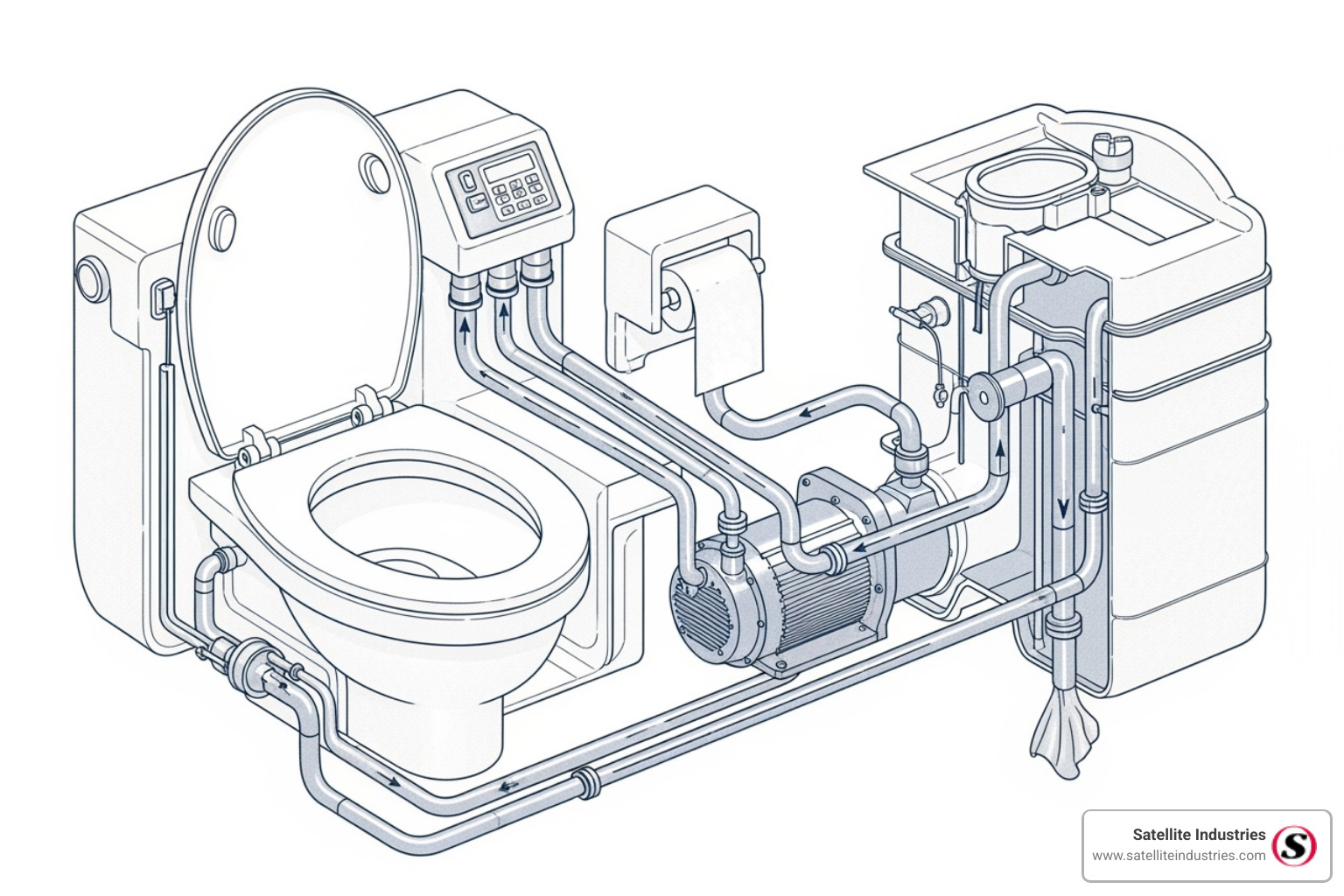
Every vacuum toilet system in aircraft has seven essential components working together. The toilet bowl assembly, made from lightweight, Teflon-coated composites, includes sensors and the flush button.
The Flush Control Unit (FCU) is the system’s brain. This electronic controller manages the flush sequence, controls valves, and reports issues to the aircraft’s central maintenance systems.
The vacuum generator, a powerful electric pump, creates suction on the ground or below 16,000 feet. At higher altitudes, natural pressure difference does the work, with the generator acting as a backup for consistent performance.
All waste goes to the waste holding tank, a large, sealed container in the aft cargo area, designed to hold waste safely on long flights.
The piping network uses smooth, 2-inch diameter pipes to connect toilets to the waste tank, preventing blockages during flight maneuvers.
Sensors and indicators constantly monitor performance, from tank levels to valve positions, alerting maintenance crews to any issues. Finally, rinse and flush valves control the flow of water and vacuum suction.
Ground Servicing: The “Honey Truck” and Waste Disposal
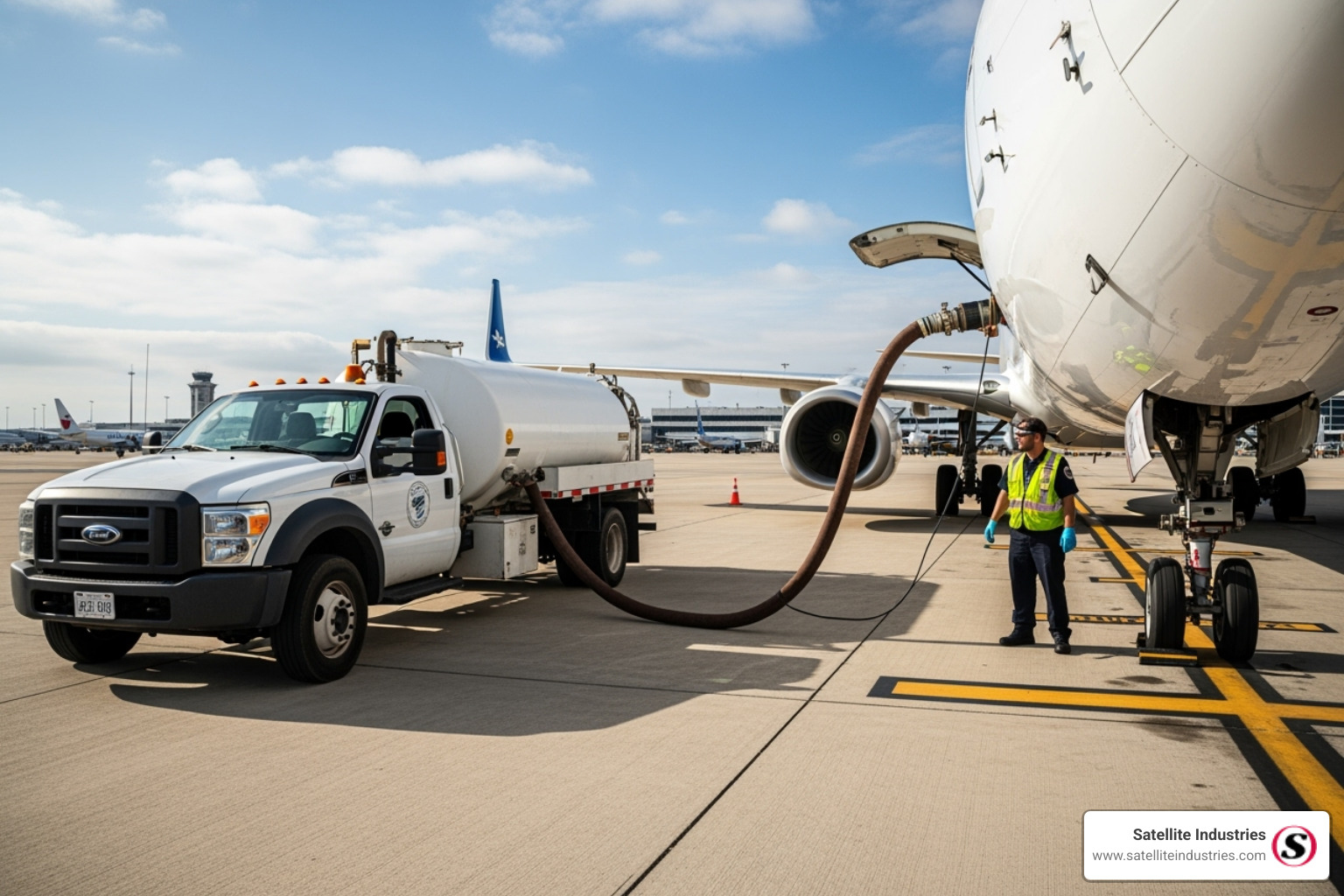
Once an aircraft lands, waste removal begins using a “honey truck.” These specialized lavatory service trucks handle an essential aspect of aircraft turnaround.
The process is straightforward and contained. Ground crew connect the truck to the aircraft’s external waste port via the lavatory service panel. Pulling the drain valve handle allows the truck’s pumps to empty the sealed waste holding tanks.
The service includes a thorough rinse with clean water and recharging with “Blue Juice,” a blue disinfectant that breaks down waste, controls odors, and prevents freezing.
For responsible disposal, all waste is transported to the airport’s wastewater treatment facility or municipal sewage system. Toilet waste is one of the many things managed by ground service vehicles and personnel, seen here in action at LAX.
Maintaining the vacuum toilet system in aircraft
The biggest enemy of the vacuum toilet system in aircraft is chemistry, not mechanical failure. The vacuum creates a “wetting and drying” effect in the pipes. Each flush’s water evaporates, leaving mineral deposits from hard water and urine salts.
These deposits can build up in the 2-inch pipes, restricting flow or causing blockages that can delay flights.
Preventative maintenance is key. Regular cleaning with specialized descaling agents dissolves mineral buildup. Curative maintenance uses more aggressive methods, like in-place descaling with stronger chemicals or high-pressure techniques for stubborn blockages.
Routine maintenance also addresses common maintenance drivers, such as replacing worn seals, cleaning solenoids, maintaining Teflon coatings, and testing flush control switches.
The detailed maintenance required for aircraft toilets mirrors our approach at Satellite Industries. Whether in the air or on the ground, reliable sanitation requires quality engineering and thorough maintenance.
From Buckets to Bidets: The Evolution and Unique Features of Aircraft Lavatories
The history of aircraft lavatories is a fascinating journey from rudimentary solutions to sophisticated engineering marvels. Early aviation toilets were, to put it mildly, basic. We’re talking simple buckets or chemical closets, often referred to as “Elsans,” which presented significant challenges, especially on long flights or in unpressurized cabins. WWII bomber crews, for instance, often struggled with overflowing chemical toilets, sometimes resorting to urinating into bottles or defecating into cardboard boxes thrown from the aircraft! One famous anecdote tells of the British Supermarine Stranraer flying boat, nicknamed the “Whistling Shithouse” because its open-air toilet’s waste pipe produced a whistling sound when the lid was lifted in flight.
Post-WWII, as commercial aviation expanded, so did the need for more civilized solutions. Chemical toilets improved slightly, often using recirculating “blue water” systems, but they were heavy, prone to corrosion, and still had odor issues. The demand for lighter, more efficient, and more hygienic systems spurred innovation, leading directly to the modern era of vacuum sanitation.
The 1975 Patent That Revolutionized Air Travel
The true revolution in aircraft sanitation came with the patenting of the modern vacuum toilet system in aircraft. This groundbreaking technology, patented by James Kemper in 1975, marked a pivotal shift from the heavy, high-water-use recirculating “blue water” systems.
Kemper’s invention laid the foundation for the lightweight, low-water flush system we know today. It allowed for the use of small-diameter pipes and eliminated the need for large, heavy water tanks, which significantly reduced aircraft weight and improved fuel efficiency. Boeing was an early adopter, starting to install vacuum toilets in their aircraft as early as 1982, setting a new industry standard. This patent effectively became the blueprint for the modern vacuum toilet system in aircraft, enabling the long-haul, comfortable flights we now take for granted. You can explore the technical details of The original vacuum toilet patent to appreciate its ingenuity.
Unique Regulations and Design Curiosities
Aircraft lavatories, despite their small size, are subject to a fascinating array of regulations and incorporate some truly unique design features.

One of the most curious features, often puzzling to passengers, is the mandatory ashtray found on lavatory doors, even though smoking has been banned on flights for decades. This isn’t an oversight; it’s a critical safety regulation. The Federal Aviation Administration (FAA), for instance, requires ashtrays to be present. The reasoning is simple: if a passenger illegally smokes, it’s far safer for them to extinguish a smoldering cigarette in a fire-safe ashtray than to discard it in a waste bin, which could lead to a catastrophic fire. This regulation underscores the rigorous fire safety regulations governing aircraft interiors. Lavatories are also equipped with smoke detectors and often Halon fire extinguishers in their waste bins, designed to automatically deploy if a fire is detected.
Beyond safety, there are other design quirks. Some premium cabins on modern aircraft, like certain Airbus A350s, even feature lavatory windows, offering an unexpected view at 35,000 feet! Furthermore, increasing attention is being paid to accessibility standards. New regulations, such as those from the U.S. Department of Transportation, mandate larger lavatories for new single-aisle aircraft to accommodate passengers with disabilities. This has spurred innovations like the ST Engineering/Acumen ‘Access’ lavatory, which creates around 40% more space for easier maneuverability, highlighting the industry’s commitment to making air travel more inclusive. This constant drive for improvement, balancing space, weight, and user needs, is something we deeply understand at Satellite Industries, applying similar principles to our own portable sanitation innovations across the Americas, Europe, Asia, Africa, Australia, and New Zealand.
Frequently Asked Questions about Aircraft Toilets
The mysteries of aircraft lavatories spark curiosity in even the most seasoned travelers. Having worked with vacuum technology for over two decades, I understand why passengers find these systems so intriguing. Let me address the most common questions we hear about the vacuum toilet system in aircraft.
Why are airplane toilets so loud?
That distinctive “whoosh” sound is actually the signature of engineering excellence at work! When you press the flush button, the system creates a dramatic pressure difference between the toilet bowl and the vacuum lines leading to the waste tank.
The powerful suction pulls air and waste through the pipes at incredibly high speeds – we’re talking about a rush of air moving fast enough to transport everything efficiently through those compact 2-inch pipes. It’s this sudden, high-velocity flow combined with the rapid opening and closing of the flush valve that creates that unmistakable noise.
Think of it as the sound of efficiency. The same principles that make our vacuum systems so effective in portable applications create that powerful “whoosh” that ensures everything gets where it needs to go, quickly and cleanly.
Is it true that waste is dumped overboard during a flight?
This persistent myth needs to be put to rest once and for all – absolutely not. All waste from the vacuum toilet system in aircraft is securely stored in sealed, airtight holding tanks built right into the aircraft’s structure. These tanks are engineered to be completely leak-proof and remain sealed throughout the entire flight.
The waste stays put until the plane lands and ground crews service it using those specialized “honey trucks” we discussed earlier. Every drop is properly contained and responsibly disposed of through airport wastewater treatment facilities.
This myth likely stems from extremely rare historical incidents called “blue ice” – small amounts of waste mixed with blue disinfectant that leaked from faulty seals decades ago, froze at high altitude, then fell to earth. Modern aircraft systems are designed to prevent such leaks entirely, and strict regulations introduced in the 1980s prohibit aircraft from taking off with any toilet system leaks. The FAA has confirmed that waste does not fall from aircraft under normal operations.
Can a person actually get stuck on an airplane toilet?
Here’s another urban legend that refuses to die, but I’m happy to report it’s completely false. While the vacuum flush is powerful enough to whisk away waste efficiently, it simply cannot create the kind of seal needed to trap a human body.
The toilet bowl design – typically that familiar horseshoe shape – makes it physically impossible to form the perfect, airtight seal that would be required for such an incident. Your body just doesn’t fit the geometry needed for this to happen.
Even more reassuring, modern vacuum toilet system in aircraft incorporate multiple safety features specifically designed to prevent excessive suction. These include pressure relief valves and vacuum breakers that automatically limit the suction pressure in the bowl area. The engineering prioritizes both efficiency and passenger safety.
So go ahead and flush with complete confidence – the system is designed to handle waste, not passengers! The same attention to safety and user-friendly design that goes into aircraft systems is something we prioritize in all our vacuum technology applications.
Conclusion
The vacuum toilet system in aircraft stands as a remarkable testament to human ingenuity, changing what was once a basic necessity into a sophisticated engineering marvel. From the humble buckets of early aviation to today’s sleek, efficient systems, this technology has quietly revolutionized how we experience air travel.
What fascinates me most about these systems is how they turn challenging physics into neat solutions. The same principles that create that distinctive “whoosh” at 35,000 feet – differential pressure, minimal water usage, and lightweight durability – represent universal truths in sanitation engineering. These aren’t just aviation innovations; they’re foundational concepts that drive efficiency across industries.
At Satellite Industries, we’ve spent decades applying these exact same engineering principles to ground-based applications. Our advanced engineering for durability and user-friendliness philosophy mirrors what makes aircraft vacuum systems so successful. Whether it’s a portable restroom serving a construction site or a sophisticated vacuum truck handling municipal waste, the core challenges remain the same: create reliable, efficient systems that work flawlessly under demanding conditions.
The evolution from James Kemper’s groundbreaking 1975 patent to Boeing’s 1982 implementation shows how transformative innovation spreads. Today’s aircraft lavatories save airlines millions in fuel costs while providing passengers with hygienic, comfortable facilities. This same innovative spirit drives our work with distributors and rental companies worldwide, helping them serve their customers across Africa, the Americas, Australia, New Zealand, East Asia, South Asia, Europe, and the Middle East.
The next time you hear that familiar whoosh during your flight, remember you’re experiencing decades of engineering excellence in action. It’s a reminder that the best technology often works so seamlessly we barely notice it – until we stop to appreciate the incredible complexity behind seemingly simple solutions.
For those interested in how these proven vacuum principles translate to terrestrial applications, we invite you to explore how our commitment to quality engineering creates long-lasting, high-performance solutions for modern sanitation challenges.
Learn more about advanced vacuum technology for modern sanitation needs.
Latest from the Satellite Industries Blog
Need Help {Finding the Right Sanitation Solution?}
Satellite Industries is the largest manufacturer of portable restrooms, restroom trailers, restroom trucks, septic trucks, slide-ins, unit haulers, vacuum technology, modular solutions, consumables and deodorizers.