The Blueprint for Better Suction: Designing Your Ideal Vacuum System
Why Vacuum System Design Matters for Your Fleet
Vacuum system design is the process of selecting and configuring vacuum components—pumps, filters, piping, and controls—to efficiently remove and transport materials while maintaining safety and reliability. Here’s what you need to know:
Key Components of a Vacuum System:
- Vacuum Source – Pumps or blowers that create negative pressure (liquid ring, rotary vane, or jet pumps)
- Filtration System – Separates debris from air to protect pumps and prevent recirculation
- Piping/Hoses – Conveys materials with minimal pressure loss through proper sizing and layout
- Collection Tank – Stores recovered material until disposal or processing
- Controls – Monitors pressure, manages flow, and ensures safe operation
Critical Design Factors:
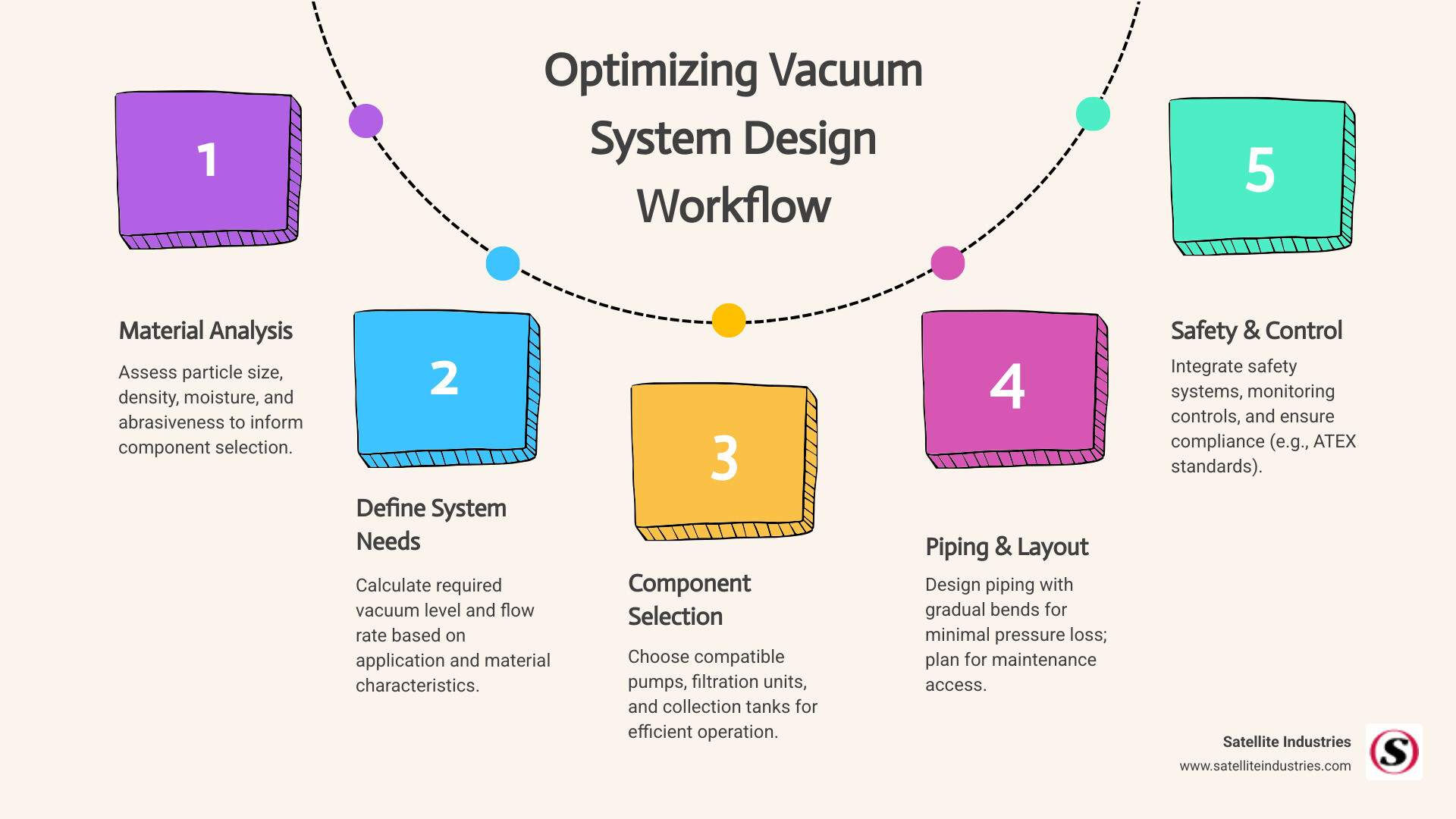
- Match vacuum level (low, medium, or high) to your material type and application
- Size pumps based on gas load, throughput (Q = P x S), and pumping speed
- Consider material properties—particle size, moisture, abrasiveness—when selecting components
- Design piping with gradual bends and proper diameter to minimize pressure drop
- Ensure safety compliance (ATEX standards for explosive atmospheres)
- Plan for maintenance access and monitoring systems
A well-designed vacuum system means fewer breakdowns, lower operating costs, and safer operations for your fleet. Poor design leads to clogged filters, pressure loss, premature pump failure, and costly downtime—problems that directly impact your bottom line and service reliability.
I’m Michelle Amelse, Vice President of Marketing and Customer Success at Satellite Industries, with over 26 years in the portable sanitation industry helping fleet operators optimize their equipment performance. Throughout my career, I’ve worked with hundreds of operators to troubleshoot vacuum system design issues and implement solutions that improve efficiency and reduce maintenance costs.
Core Principles of Industrial Vacuum System Design
Understanding the core principles behind industrial vacuum system design helps you make smart, cost-effective choices that drive efficiency, reliability, and safety across your fleet.

Sizing Your System: Vacuum Levels, Pumps, and Gas Flow
Right-sizing begins with matching vacuum level and flow to the job.
Vacuum levels:
- Low Vacuum (0 to -0.5 bar): Light debris and general cleanup.
- Medium Vacuum (-0.5 to -0.8 bar): Standard industrial dust and denser materials.
- High Vacuum (below -0.8 bar): Heavy-duty removal and abrasive materials.
Account for gas load (air ingress, outgassing, permeation) and use throughput to size components: Q = P x S (throughput = pressure x pumping speed). Piping conductance (C) throttles performance; the net pumping speed follows 1/Snet = 1/Spump + 1/Cpiping. Aim for high-conductance piping so Snet approaches S_pump.
No single pump covers the full vacuum regime efficiently. It’s often better to use multiple pumps for different pressure zones than to oversize one unit and rely on complex controls.
Pump TypePerformance CharacteristicsApplication SuitabilityLiquid RingHigh reliability, handles liquids/solids, good vacuum depth.Vacuum trucks, wastewater, chemical/process duties, portable sanitation; great with slurries and entrained liquid.Rotary VanePositive displacement, robust, good rough-to-medium vacuum.General vacuum generation, HVAC/service, labs; less ideal for heavy solid transfer.Jet Pump (Venturi System)Simple, few moving parts, durable, low maintenance.Creating vacuum for liquid/slurry transfer and suction; valued for simplicity and minimal wear.
Selecting the Building Blocks: A Guide to Key Components
A high-performing system blends compatible components that protect uptime and safety.
- Vacuum Generation Equipment: Liquid ring, rotary vane, or jet/venturi systems—selected for required vacuum level, flow, and material type.
- Filtration Units: Protect pumps and stop recirculation; use cartridge or sintered media as needed. Pulse-jet cleaning supports continuous operation.
- Piping and Conveying Lines: Size for conductance and conveying velocity; choose wear-resistant materials for abrasives.
- Valves (isolation, throttling, vent): Select for pressure rating, tightness, and minimal conductance loss.
- Vacuum Gauges: Combine direct/indirect gauges across ranges; note gas composition can affect indirect readings.
- Fittings (KF, CF, ISO): Match vacuum range and service; metal seals for high/ultra-high vacuum or infrequent disconnects.
- Control and Safety Systems: Sensors, interlocks, and explosion-proof components; monitoring to spot performance drift early.
The Impact of Material Properties on Your Design Choices
Material characteristics drive pump, filter, and piping decisions.
Consider:
- Particle size and density
- Abrasiveness and corrosiveness
- Moisture/stickiness
Design impacts:
- Pump selection: Liquids/slurries favor liquid ring; dry, fine powders may need pre-separation and different pump technologies.
- Filtration: Use media and cleaning methods suited to dust type; sintered options for abrasive/corrosive dusts.
- Piping: Heavy-duty or hardened materials and larger-radius bends for abrasive streams; size to maintain conveying velocity without excessive pressure loss.
Engineering for Performance, Safety, and Longevity
Now that we understand the fundamental building blocks, it’s time to put them together. Engineering for performance, safety, and longevity means creating a system that not only gets the job done but does so reliably, efficiently, and with minimal risk throughout its operational lifetime. This is where the practical application of design principles truly shines.
Optimizing Flow: Best Practices for Piping and Layout
Think of your vacuum system’s piping as a highway for materials. Just as traffic jams slow down cars, bottlenecks and sharp turns can significantly reduce the efficiency of your vacuum system. Our goal in vacuum system design is to create a smooth, unobstructed flow to minimize pressure loss.
Here are our best practices:
- Minimize Pressure Loss: The longer and more convoluted the piping, the greater the pressure loss. We aim for the shortest possible runs with the fewest changes in direction.
- Use Gradual Bends, Avoid Sharp Turns: Sharp 90-degree elbows are the enemy of efficient flow. They create turbulence, increase friction, and accelerate wear, especially with abrasive materials. Instead, we use gradual, long-radius bends to reduce pressure drop and wear.
- Calculate Proper Line Sizes: Just as a too-small pipe restricts flow, an excessively large one can reduce conveying velocity, causing materials to settle. Proper line sizing ensures materials are transported effectively without unnecessary energy expenditure.
- Horizontal vs. Vertical Runs: While we can’t always avoid vertical lifts, we should account for all vertical and horizontal distances and changes in direction. Vertical runs inherently require more energy to lift material against gravity.
- Common Challenges and Solutions:
- Filter Clogging: This is a classic headache. Our solution? Incorporate pulse jet cleaning into filtration units. This technology enables continuous operation by periodically blasting filters clean, significantly reducing manual cleaning frequency and optimizing airflow.
- Pressure Drop: Beyond proper sizing and gradual bends, we must avoid excessive vacuum levels. While it might sound counterintuitive, too much vacuum can sometimes damage materials or equipment and isn’t always the most efficient solution. Instead, we focus on optimizing the entire system for smooth flow.
- Dust Leakage: Regular inspection and maintenance of seals and connections are crucial to prevent dust leakage, ensuring captured dust stays contained.
Ensuring Safety and Compliance in Vacuum System Design
Safety isn’t just a buzzword; it’s a non-negotiable pillar of effective vacuum system design, especially in hazardous environments. When dealing with combustible dust or explosive atmospheres, our systems must be built to the highest standards to protect personnel and property.
- Hazardous Environments and Combustible Dust: Many industrial processes involve materials that, when airborne in dust form, can be explosive. Think fine powders in manufacturing, or certain organic materials. Specialized filtration technologies are absolutely essential here to safely capture combustible dust and airborne particles, preventing them from becoming an ignition hazard. If we’re handling explosive materials, we consider explosion vents and fire suppression systems as integral parts of the design.
- Safety Standards and ATEX Compliance: In regions like Europe, vacuum systems designed for explosive atmospheres must comply with strict safety standards such as ATEX. This isn’t just a guideline; it’s a legal requirement that dictates everything from component selection to system installation. Compliance ensures that our equipment won’t be an ignition source in potentially volatile conditions.
- Ignition Source Prevention: Our design must actively minimize potential ignition sources. This means preventing dust accumulation, which can fuel an explosion. It also involves managing static discharge, a common ignition culprit. We implement grounding and anti-static measures throughout the system, ensuring hoses and tools are properly grounded if necessary. Overheating risks, particularly in pumps and motors, also need to be mitigated through proper ventilation and monitoring.
- Fall-Protection Integration: Beyond the vacuum process itself, safety during operation and maintenance is critical. For instance, in applications like specialized vacuum trucks for sewer jetting, integrating fall-protection harnesses can significantly decrease safety-related incidents during liftd work. This holistic approach to safety covers the entire operational lifecycle of the equipment.
By diligently adhering to these safety principles and compliance requirements, we ensure our vacuum systems are not only productive but also operate with the utmost regard for human life and environmental protection.
Designing for the Real World: Portability, Controls, and Maintenance
A truly effective vacuum system design anticipates the real-world demands of its environment. This means balancing the need for permanent, robust installations with the flexibility of portable solutions, integrating smart controls, and always keeping maintenance in mind.
- Permanent vs. Portable Systems:
- Permanent Installations: These are typically hard-piped configurations, designed for durability and a longer, maintenance-free life in a fixed location. They are ideal for continuous operations where the vacuum source and collection points remain static.
- Portable Applications: Our portable systems, like the Dyna-Lite pumping system ideal for emptying grease traps and catch basins, are configured using heavy-duty industrial hoses for mobility. For these systems, we ensure forklift slots and sling brackets are available for safe and easy movement. The design prioritizes ease of transport and quick setup, making them perfect for varied job sites.
- Control and Monitoring Systems: These systems are the eyes and ears of our vacuum operations, playing a crucial role in both daily operation and long-term maintenance.
- Automated Controls: Manifolding air to differing vacuum pressures dynamically often requires sophisticated automated controls. While the cost of these systems (including SCADA for monitoring) can sometimes exceed that of multiple individual vacuum pumps, the efficiency gains and precision can be invaluable for complex operations.
- Monitoring: Front-mounted digital display operation screens with diagnostic and troubleshooting capabilities provide operators with real-time feedback. Remote-controlled vacuuming and water systems, as seen in some specialized equipment, even enable efficient one-man operation. Remote start/stop locations can also improve convenience and safety. Implementing robust monitoring systems allows for early detection of performance degradation, enabling proactive maintenance rather than reactive repairs.
- Designing for Easy Maintenance: The best system is one that’s easy to keep running. We design our systems for easy access to filters and vacuum pumps for maintenance, minimizing downtime. This includes:
- Accessible Components: Ensuring filters, pumps, and other high-wear parts are easy to reach, inspect, and replace.
- Diagnostic Tools: Control systems with diagnostic capabilities help pinpoint issues quickly, reducing troubleshooting time.
- Durability for Reduced Maintenance: While some manufacturers boast “maintenance-free” designs, we focus on engineering for durability to inherently reduce the frequency and complexity of maintenance. A well-executed design balances power, safety, and maintenance needs.
- Reliability and Operational Lifetime: We want a system that performs reliably for its entire operational lifetime. Investing in a thorough design phase, where over 70% of the final cost is defined, pays dividends in the long run. Working with experienced design engineers from the start can help us ensure the best possible solution, reaping many benefits both near and long term in terms of overall performance. Our goal is to create solutions that are not only efficient and safe but also robust enough to handle the rigors of your operations, contributing to your profitability and reputation.
We at Satellite Industries are committed to providing advanced engineering for durability and user-friendliness in our vacuum technology. Explore our advanced vacuum technology solutions and see how our commitment to quality translates into reliable performance for your fleet: https://www.satelliteindustries.com/.
Latest from the Satellite Industries Blog
Need Help {Finding the Right Sanitation Solution?}
Satellite Industries is the largest manufacturer of portable restrooms, restroom trailers, restroom trucks, septic trucks, slide-ins, unit haulers, vacuum technology, modular solutions, consumables and deodorizers.