The Potty Patrol: Your Go-To Guide for Disaster Relief Sanitation
When Disaster Strikes: The Critical Need for Emergency Sanitation
Portable sanitation for disaster relief becomes an immediate lifeline when hurricanes, earthquakes, floods, or wildfires destroy basic infrastructure and displace thousands of people. When traditional plumbing fails and communities are left without essential services, portable restrooms, handwashing stations, and shower trailers prevent disease outbreaks while maintaining human dignity during the most challenging times.
Quick Reference: Essential Disaster Relief Sanitation Solutions
- Standard portable restrooms: 1 unit per 20 people for basic coverage
- ADA-compliant units: Required for accessibility and inclusion
- Handwashing stations: Critical for disease prevention
- Restroom trailers: Long-term comfort for evacuation centers
- Shower trailers: Essential for extended displacement situations
- Vacuum service trucks: Maintain hygiene through regular waste removal
As one disaster relief coordinator noted after Hurricane Sandy, “sanitation teams remained on-site for three months to assist with relief efforts” – highlighting how portable sanitation isn’t just a short-term need, but often a months-long commitment to community recovery.
The 2011 Joplin tornado destroyed nearly 25% of the city, while Hurricane Sandy affected more than 24 states. During the 2020 California wildfires, Bay Area Sanitation provided over 100 units across multiple evacuation sites. These real-world scenarios show why portable sanitation operators need durable, rapidly deployable equipment that can withstand harsh conditions while serving hundreds of people daily.
I’m Michelle Amelse, Vice President of Marketing and Customer Success at Satellite Industries, with over 26 years of experience in the portable sanitation industry, including extensive work with disaster relief applications. My background in strategic marketing and deep understanding of portable sanitation for disaster relief requirements helps operators choose the right equipment for these critical missions.
Why Sanitation is the Unsung Hero of Disaster Response
When disaster strikes, everyone talks about food, water, and shelter. But there’s another hero working quietly behind the scenes – one that doesn’t get the headlines but literally saves lives. Portable sanitation for disaster relief is that unsung hero, preventing secondary disasters from spiraling out of control.
Think about it: when hurricanes flood sewage systems or earthquakes crack water mains, where do thousands of displaced people go? Without proper facilities, a health crisis becomes inevitable. That’s why smart operators know that portable sanitation isn’t just helpful during disasters – it’s absolutely essential.
Mitigating Critical Health Risks
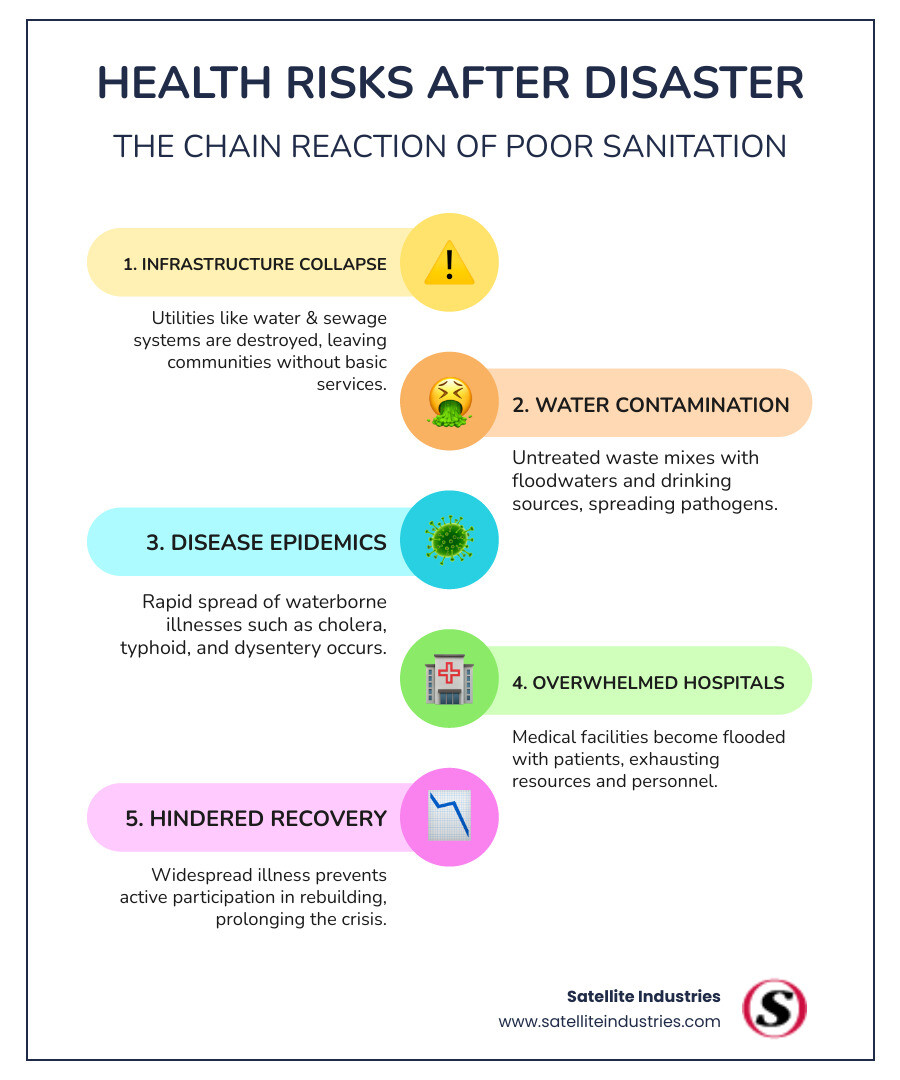
When infrastructure crumbles, the clock starts ticking toward a public health nightmare. Broken sewer lines, contaminated water supplies, and power outages create the perfect storm for disease outbreaks.
Without proper facilities, people have no choice but to use unsafe areas for basic needs. This quickly leads to contamination of water sources and the surrounding environment. The result? Waterborne diseases like dysentery and cholera spread rapidly through affected communities.
Scientific research on how disasters impact public health consistently shows that broken infrastructure becomes the primary driver of pathogen spread after disasters. Germs causing diarrhea, respiratory infections, and other serious illnesses multiply quickly without proper hygiene facilities, overwhelming medical facilities that are already stretched thin.
Portable sanitation for disaster relief stops this cycle before it starts. Self-contained units don’t rely on damaged water or power systems. They create immediate barriers against contamination, protecting the health of entire communities when they’re most vulnerable.
Supporting First Responders and Victims
Beyond preventing disease outbreaks, portable sanitation provides something equally important but harder to measure: dignity and a sense of normalcy during chaos.
Picture a family who just lost their home to flooding, now crowded into an emergency shelter with hundreds of other displaced people. Having access to private, clean facilities offers more than convenience – it provides a crucial psychological well-being boost and helps maintain their dignity during an incredibly stressful time.
For first responders and recovery teams, proper sanitation isn’t a luxury – it’s operational necessity. These heroes work grueling shifts rescuing people from collapsed buildings, fighting fires, and coordinating relief efforts. Clean, accessible restrooms help them maintain their health and focus, directly improving their operational efficiency.
The morale boost extends to volunteers and support staff too. When people know they have access to proper facilities, they can concentrate on helping others instead of worrying about basic needs. This creates a ripple effect that makes the entire relief operation run more smoothly.
Portable sanitation for disaster relief doesn’t just prevent health crises – it supports the human spirit when people need it most. That’s why it truly deserves recognition as one of disaster response’s greatest unsung heroes.
Gearing Up: Types of Portable Sanitation for Disaster Relief
When disaster strikes, having the right equipment can mean the difference between chaos and organized relief. At Satellite Industries, we’ve learned that portable sanitation for disaster relief isn’t one-size-fits-all. Different emergencies call for different solutions, and smart operators know that building a diverse fleet is key to winning contracts and serving communities effectively.
Think of it like a toolbox – you wouldn’t bring just a hammer to build a house. Similarly, disaster response requires everything from basic units for rapid deployment to luxury trailers for long-term recovery operations. Our advanced engineering focuses on durability, user-friendliness, and scalability because when you’re setting up base camps in hurricane-force winds or serving hundreds of displaced families, your equipment better work flawlessly.
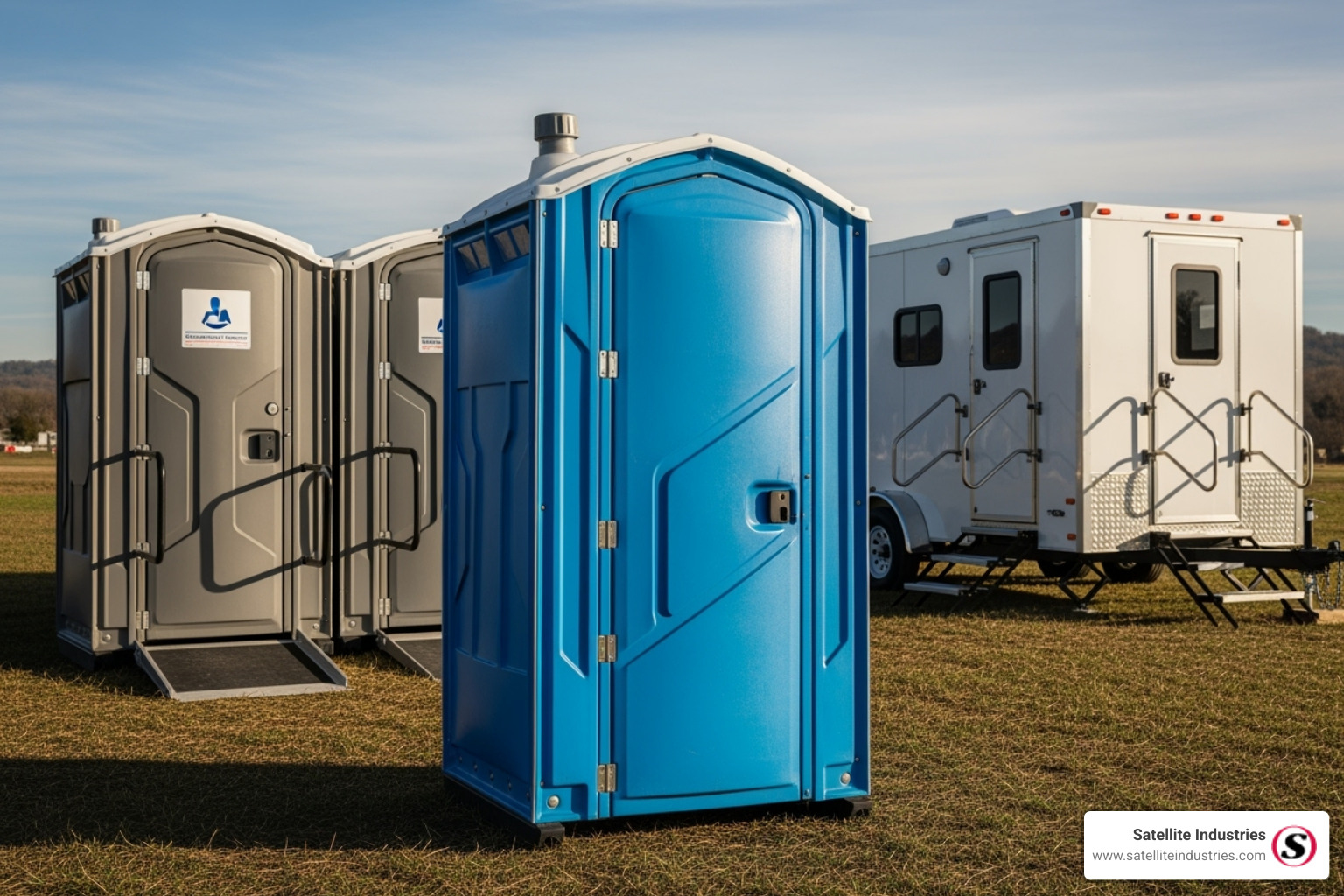
Core Units for Mass Deployment
Standard portable restrooms are the workhorses of disaster response. When FEMA needs 200 units deployed within 24 hours, these are what get the job done. We build ours from high-density polyethylene because it’s practically indestructible – think of it as the material that laughs at flying debris and extreme temperatures.
The magic is in the details that keep these units functioning when everything else fails. High-capacity waste tanks mean fewer service calls when your trucks are struggling through flooded roads. Non-slip floors prevent injuries when stressed people are navigating unfamiliar facilities in the dark. Adequate ventilation keeps conditions bearable even in sweltering heat, while easy-to-clean surfaces help your crews maintain hygiene standards when they’re servicing dozens of units per day.
What makes these units truly shine is their ease of transport. When you need to move fast, every minute counts. Our standard units stack efficiently on trucks and set up quickly, letting you focus on serving people instead of wrestling with complicated equipment.
Specialized Equipment for Comprehensive Support
Sometimes basic isn’t enough. When relief operations stretch from days into months, or when you’re serving VIP command posts, specialized equipment becomes your competitive advantage.
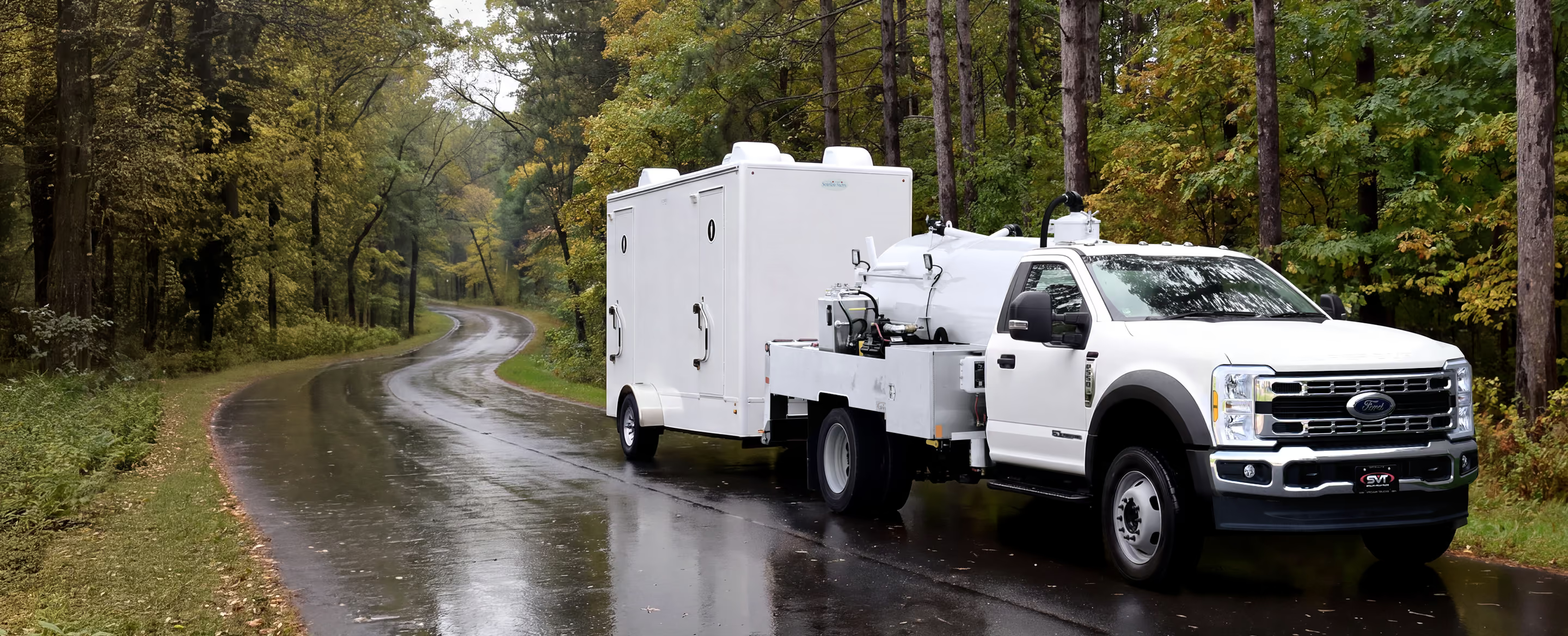
Restroom trailers transform the disaster relief experience. Picture displaced families who’ve lost everything – giving them access to flushing toilets, running water, and climate control isn’t just comfort, it’s dignity. Our Deluxe Comfort Stations handle 150-300 guests, while Premium Comfort Stations serve 300-500 guests, making them perfect for large evacuation centers.
Shower trailers are absolute game-changers for extended deployments. After days without running water, a hot shower can lift spirits and prevent health issues. Our units come with hot running water, private changing areas, and storage space – because nobody wants to get dressed in a puddle. We also manufacture ADA-compliant shower trailers, ensuring everyone can maintain their hygiene with dignity.
Don’t overlook laundry facilities for long-term operations. When first responders are on-site for months (like they were after Hurricane Sandy), clean uniforms aren’t a luxury – they’re essential for health and morale. We’ve created custom laundry trailers specifically for disaster response because we understand that comprehensive support means thinking beyond just toilets.
Our Vacuum Technology modules represent the cutting edge of portable sanitation for disaster relief. These self-contained systems are engineered for the continuous operation that FEMA and Red Cross sanctuary camps demand, delivering efficiency and reliability when failure isn’t an option.
Essential Hygiene and Accessibility Units
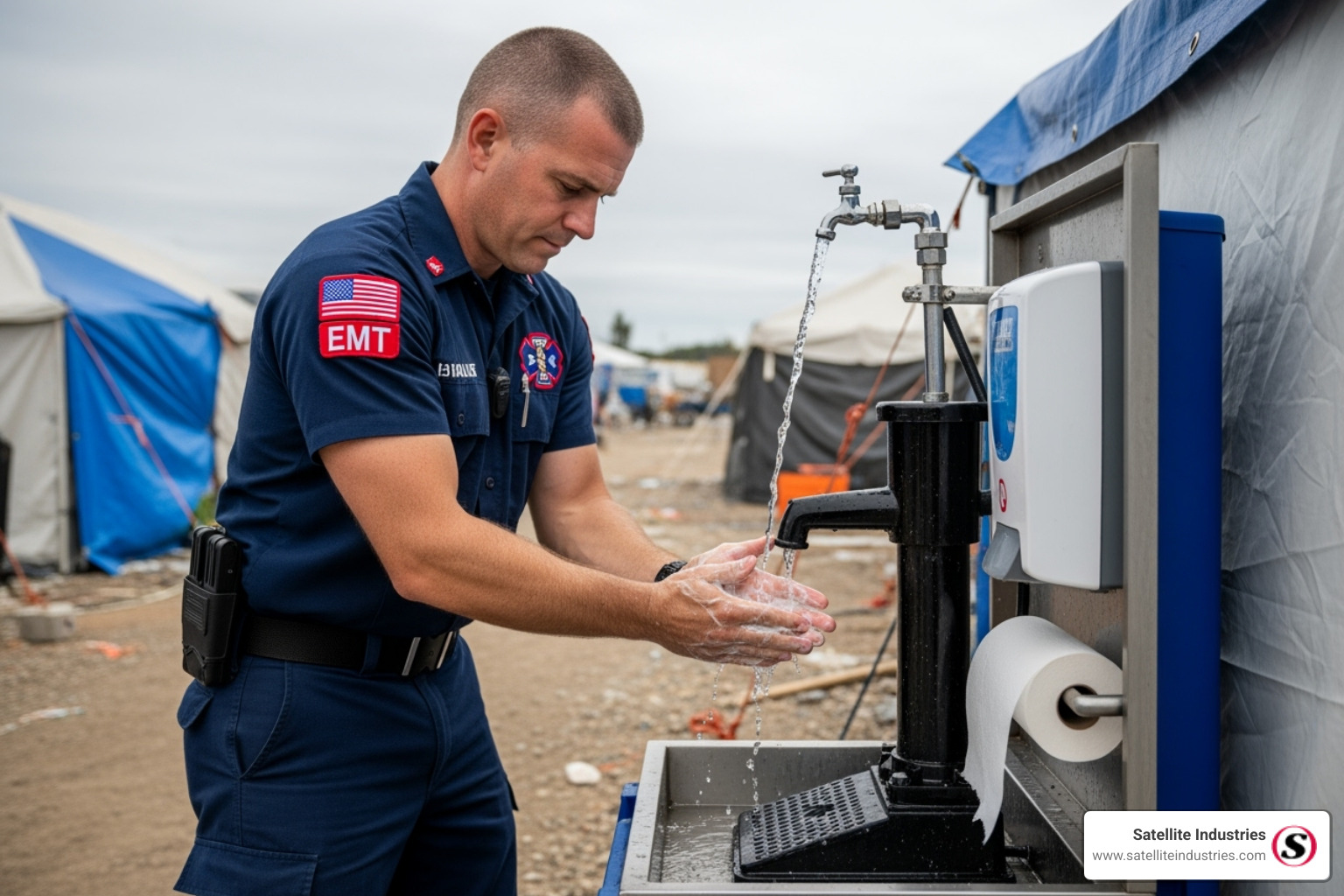
Hand hygiene can literally save lives in disaster scenarios, making handwashing stations as critical as the restrooms themselves. Our standalone units come equipped with soap dispensers and paper towels, and when water quality is questionable, we can supply special chlorine tablets to ensure safe, clean water for washing.
Hand sanitizer dispensers provide that crucial backup when water isn’t available. Whether integrated into restrooms or standalone units, they’re your first line of defense against disease outbreaks that can devastate already vulnerable communities.
ADA-compliant restrooms aren’t just about following OSHA guidelines – they’re about ensuring everyone has access to dignity during their darkest hours. Our units feature wider entryways, sturdy handrails, and wheelchair-accessible design. Our Elite Comfort Stations and ADA Comfort Stations accommodate 50-125 guests while maintaining full accessibility.
The beauty of building a diverse fleet is versatility. One day you might be supporting wildfire evacuees with basic units, and the next you’re providing luxury trailers for a hurricane command center. With the right mix of equipment, you’re ready for whatever disaster throws your way.
The Logistics of Deployment: Overcoming Emergency Challenges
When chaos erupts after a disaster, getting sanitation equipment where it’s needed most becomes a complex puzzle that requires both speed and strategy. It’s not simply about loading trucks and driving to the affected area – successful portable sanitation for disaster relief deployment demands careful planning, lightning-fast response times, and the ability to maintain operations in environments where nothing works the way it should.
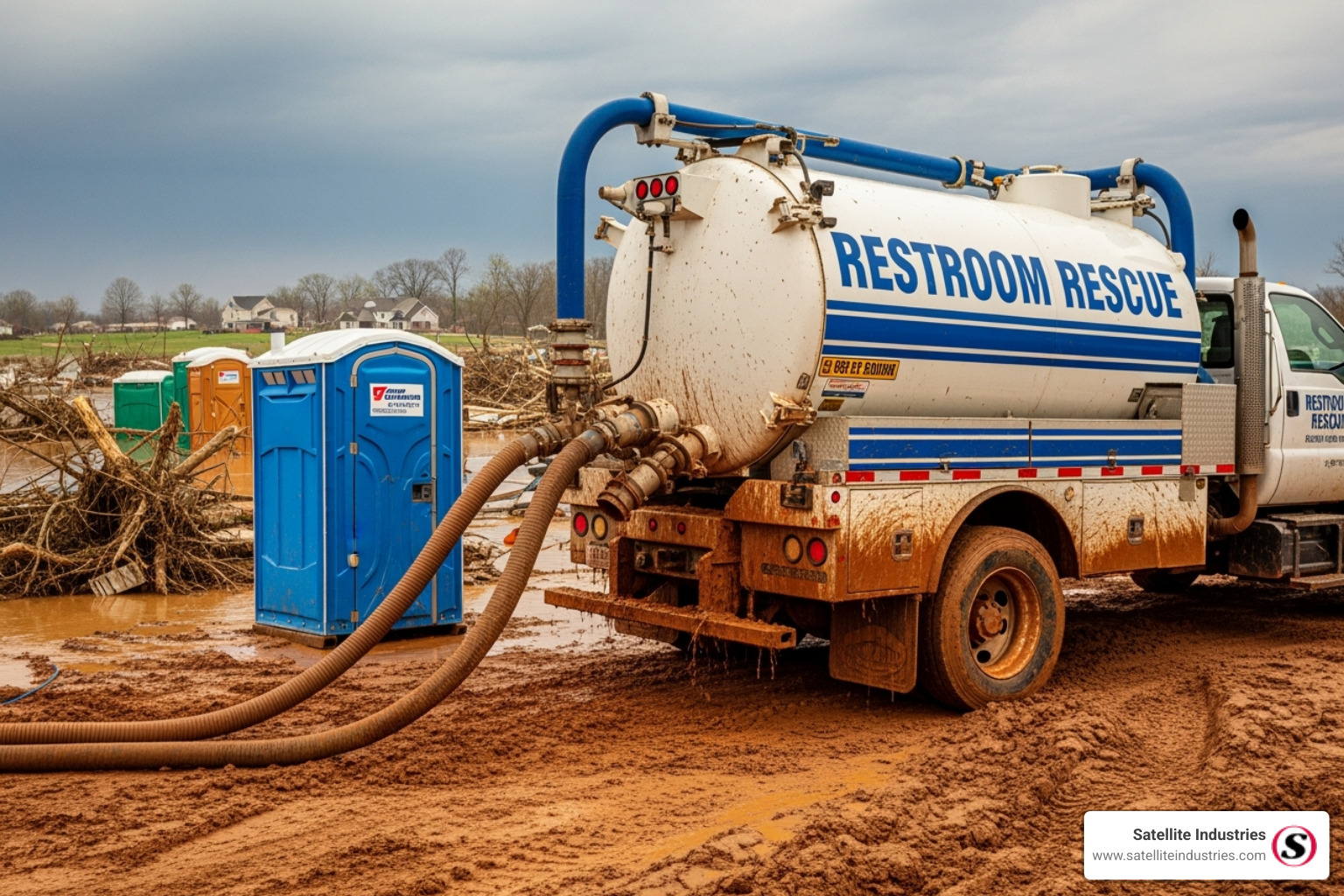
Rapid Response and Placement Strategy for Portable Sanitation for Disaster Relief
The first 24 hours after a disaster strikes are absolutely critical. We’ve witnessed portable sanitation operators successfully deliver units to hurricane-affected areas within a single day of receiving the emergency call. This kind of rapid response can mean the difference between maintaining public health and facing a secondary crisis from disease outbreaks.
But speed without strategy creates its own problems. Strategic placement requires thinking like both a logistics expert and a public health professional. Units need to be close enough to evacuation centers and command posts for easy access, yet positioned to minimize contamination risks. They must be visible enough that people can find them in unfamiliar surroundings, but discreet enough to maintain dignity and privacy.
Weather resistance becomes paramount when you’re dealing with the aftermath of storms or in areas where conditions remain unstable. Our units are engineered with securing systems that prevent tipping during high winds and anchoring options for unstable ground. We’ve learned from experience that a unit that can’t stay upright or secure isn’t just useless – it becomes another hazard in an already dangerous situation.
Service and Waste Management in a Crisis
Deploying the units is honestly the easy part. Keeping them clean and functional when traditional infrastructure has completely collapsed? That’s where the real challenge begins, and where our advanced engineering truly shines.
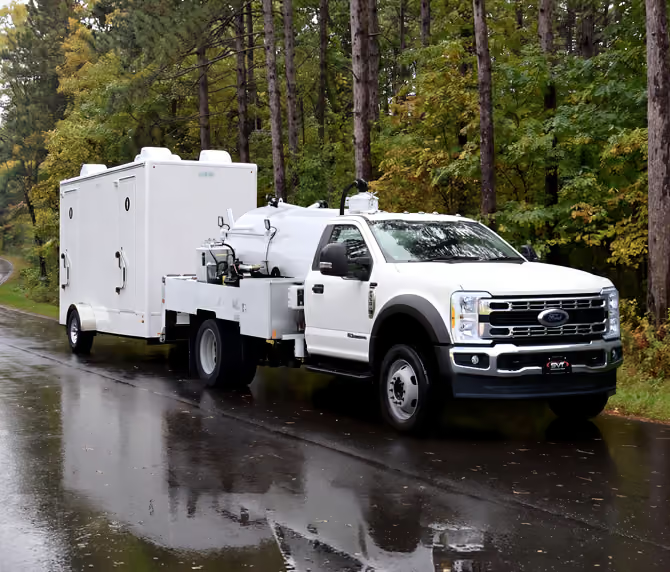
Vacuum trucks become the lifeline of disaster relief sanitation. These specialized vehicles steer through debris-filled streets and damaged roads to ensure waste removal continues like clockwork. Our vacuum technology is designed to work efficiently even when operators are dealing with challenging access routes and time pressures that would overwhelm standard equipment.
The holding tank systems in our restroom and shower trailers allow for extended independent operation – sometimes for days at a time between services. This capability is crucial when you’re supporting large evacuation centers or when road conditions make frequent servicing impossible.
Maintaining rigorous pumping schedules in disaster zones requires equipment that’s both reliable and user-friendly. Our designs prioritize quick, efficient servicing because when you’re managing hundreds of displaced people, there’s no room for equipment failures or complicated maintenance procedures. Every minute saved during servicing means more time available for helping people in need.
Choosing the Right Equipment for the Job
After decades in this industry, I’ve seen how the right equipment choices can make or break a disaster response operation. The features that matter most in portable sanitation for disaster relief aren’t always the same ones that work best for everyday applications.
Structural durability tops the list because disaster environments are unforgiving. Units face extreme weather, constant heavy use, and transportation over damaged roads. Our robust, impact-resistant materials ensure your equipment keeps working when people need it most. Ease of cleaning becomes critical when you’re servicing units multiple times per day in high-stress situations – smooth surfaces and accessible compartments make the difference between manageable and overwhelming workloads.
Transportability matters more than you might expect. Lightweight yet sturdy construction means you can position units in remote locations or move them quickly as situations evolve. Off-grid capability is non-negotiable since disaster zones often have no functioning water, power, or sewage systems for weeks or months.
The most successful operators invest in equipment that combines user-friendliness with reliable components. When children, elderly residents, and people with disabilities are using your facilities during the most stressful time of their lives, intuitive design isn’t just helpful – it’s essential for maintaining dignity and preventing additional problems.
These features provide genuine long-term value because they ensure you’re always ready to respond effectively, regardless of what type of disaster strikes your service area.
Lessons from the Field: Portable Sanitation in Action
The real measure of portable sanitation for disaster relief isn’t in specifications or features—it’s in how these units perform when communities face their darkest hours. Over decades of supporting portable sanitation operators, we’ve witnessed how the right equipment can mean the difference between chaos and order, between illness and health, between despair and dignity.
These aren’t just statistics or case studies. They’re stories of real people—families who lost everything, first responders working around the clock, and the dedicated operators who deploy our equipment to serve them all.
Hurricane Response: Long-Term Deployment
Hurricanes bring a unique challenge: widespread devastation that requires months of sustained support. The scale is staggering, and the commitment required from portable sanitation operators is immense.
When Hurricane Katrina struck in 2005, it changed how we think about disaster response forever. The catastrophic flooding and infrastructure collapse left hundreds of thousands without basic services. Portable sanitation for disaster relief became a lifeline, not just for displaced families, but for the army of first responders and volunteers who came to help.
Our operators worked alongside FEMA, the American Red Cross, and the Department of Homeland Security to establish full-service base camps. These weren’t just collections of portable toilets—they were comprehensive sanitation solutions including shower trailers, restroom trailers, and even mobile command centers. The crews stayed for months, maintaining these essential services as communities slowly rebuilt.
Hurricane Sandy in 2012 showed us how quickly disaster can spread across multiple states. Affecting over 24 states, this superstorm required operators to think bigger and move faster than ever before. What impressed us most was watching our customers deploy units within 24 hours of the first calls for help.
The three-month deployment that followed demonstrated the versatility of modern portable sanitation for disaster relief. Beyond standard units, operators provided ADA-compliant shower facilities, ensuring that everyone—regardless of physical ability—had access to dignity and cleanliness during their time of need. These weren’t temporary fixes; they were comprehensive solutions that supported thousands of people through months of uncertainty.
Tornado & Wildfire Relief: Rapid Deployment
While hurricanes demand endurance, tornadoes and wildfires test how quickly operators can respond. These disasters strike with little warning, creating immediate, intense needs that require split-second decision-making.
The 2011 Joplin tornado remains one of the most powerful reminders of nature’s destructive force. An EF5 multi-vortex tornado destroyed nearly 25% of the city in minutes. When the winds stopped, entire neighborhoods had vanished, and basic infrastructure was obliterated.
Our operators responded with portable restroom trailers and pro-flush water systems, establishing sanitation services at command centers and in areas where nothing else remained standing. The speed of deployment was crucial—every hour without proper sanitation increased the risk of disease outbreak in an already traumatized community.
California’s 2020 wildfire season brought a different kind of challenge. Fires don’t just destroy—they force rapid evacuations, creating instant communities of displaced families in evacuation centers. Bay Area Sanitation provided over 100 units across multiple evacuation sites in San Francisco, supporting both evacuees and the firefighters battling the blazes.
What struck us about the wildfire response was how portable sanitation for disaster relief had to be everywhere at once. Units were needed at evacuation centers for families who fled with nothing, at staging areas for firefighters working in remote locations, and at command posts coordinating the massive response effort. The versatility and reliability of properly engineered equipment made all the difference.
These real-world experiences teach us that disaster relief isn’t just about having the right equipment—it’s about having equipment that works when everything else fails, equipment that can be deployed rapidly and maintained under the most challenging conditions, and equipment that treats every person with dignity when they need it most.
Frequently Asked Questions for Sanitation Providers
Planning to serve communities during their darkest hours? As portable sanitation providers, you’re stepping into one of the most meaningful roles in disaster response. Over my 26 years in this industry, I’ve seen how the right preparation can make the difference between chaos and coordinated relief efforts.
Let me share some insights to help you gear up for these critical missions.
How do I prepare my business for a disaster response contract?
Getting ready for disaster response isn’t something you can do overnight. It requires thoughtful planning and investment in both equipment and processes.
Inventory management forms the backbone of your disaster readiness. You’ll want a robust fleet that includes standard units for mass deployment, ADA-compliant restrooms for accessibility, and restroom trailers for longer-term situations. Don’t forget the consumables – hand sanitizer, toilet paper, and deodorizers disappear quickly in high-volume scenarios. Our high-capacity waste tanks and durable construction mean your units can stay deployed longer between services, which becomes crucial when you’re working in remote disaster zones with challenging access.
Staff training makes all the difference when time is critical. Your team needs to know how to secure units against high winds, steer damaged roads, and service equipment efficiently under pressure. Emergency protocols and safety procedures aren’t just paperwork – they’re lifelines when you’re operating in unstable environments.
Logistical planning separates the prepared from the overwhelmed. Develop multiple route options for areas where main roads might be impassable. Build relationships with fuel suppliers, water sources, and waste disposal facilities before you need them. Consider how you’ll communicate with your team when cell towers are down.
Building a deployable fleet means ensuring your vacuum trucks and transport vehicles are always ready for immediate dispatch. Regular maintenance isn’t optional when you might get a call at 2 AM to deploy 50 units by dawn.
Insurance and contracts with government agencies like FEMA or relief organizations have specific requirements. Understanding these upfront prevents delays when communities are counting on you.
What are the most important features in portable sanitation for disaster relief?
When you’re selecting equipment for portable sanitation for disaster relief, certain features become absolutely non-negotiable.
Durability stands above everything else. Your units will face conditions they were never meant to handle – hurricane winds, flood debris, and round-the-clock use by stressed individuals. High-density polyethylene construction and impact-resistant materials aren’t luxury features; they’re survival requirements. I’ve seen units that looked fine on paper fail completely when faced with real disaster conditions.
Easy cleaning and servicing becomes critical when you’re managing hundreds of units across multiple sites. Smooth, non-porous surfaces and efficient waste tank designs can cut your service time in half. When you’re working 16-hour days in challenging conditions, every minute saved matters. Our advanced engineering focuses on making units as user-friendly for service technicians as they are for the people using them.
Transportability and stability work hand in hand. Units must move easily whether you’re loading them onto trucks, trailers, or even helicopters for remote locations. But once they’re placed, they need anchoring systems that can handle unstable ground and high winds. A tipped-over unit creates more problems than it solves.
Self-contained operation isn’t just convenient – it’s essential. When water treatment plants are flooded and power grids are down, your units need to function completely independently. Chemical toilets and integrated water systems keep working when everything else fails.
How many units are needed per person in a disaster relief setting?
The standard guideline of one toilet per 20 people gives you a starting point, but disaster relief is never that simple. Every situation demands its own calculation.
Duration changes everything. A temporary evacuation center operating for three days has completely different needs than a relief camp housing families for three months. Short-term sites might manage with basic coverage, but extended deployments require restroom trailers, shower facilities, and more frequent servicing to maintain health and morale.
The type of facility dramatically affects your planning. A 24-hour relief camp where displaced families are living needs comprehensive sanitation solutions. A staging area for daytime volunteers has lighter requirements. Base camps for first responders fall somewhere in between but demand reliability above all else.
Accessibility requirements aren’t optional. Plan for ADA-compliant units – typically one for every 20 standard units or at least one per site. These aren’t just regulatory requirements; they’re about ensuring everyone has dignified access to essential facilities during crisis.
Existing infrastructure might influence your numbers, but assume the worst. Even partially functional traditional restrooms often fail completely as situations develop. It’s always better to over-estimate than to leave a community without adequate portable sanitation for disaster relief.
Insufficient facilities don’t just create discomfort – they can trigger disease outbreaks that undermine every other relief effort. Your role in preventing that secondary disaster cannot be overstated.
Conclusion
When disaster strikes and communities face their darkest hours, portable sanitation for disaster relief stands as a guide of hope and dignity. Throughout this guide, we’ve explored how proper sanitation goes far beyond basic necessity – it’s the foundation that prevents secondary health crises, maintains human dignity, and supports the heroes working tirelessly to rebuild lives.
The lessons are clear: preparedness is key. Whether you’re responding to a hurricane that requires months-long deployment or a wildfire demanding immediate evacuation support, having the right equipment ready makes all the difference. From durable standard units that can withstand harsh conditions to specialized restroom and shower trailers that provide long-term comfort, each piece of equipment plays a vital role in supporting communities when they need it most.
We’ve seen how strategic deployment, reliable waste management, and continuous service create the backbone of successful disaster response operations. The stories from Hurricane Katrina, Hurricane Sandy, the Joplin tornado, and countless wildfires remind us that supporting communities through their recovery isn’t just about providing facilities – it’s about restoring hope and normalcy when everything else has been swept away.
At Satellite Industries, our commitment to advanced engineering ensures that every portable restroom, trailer, truck, and vacuum technology system we manufacture can handle the demanding conditions of disaster relief. Our durable equipment is designed not just to function, but to excel when stakes are highest and conditions are toughest.
As a provider, investing in well-engineered, durable, and easy-to-service equipment is critical for success in challenging disaster relief scenarios. When communities are counting on you, reliability isn’t just important – it’s everything.
The next disaster is always around the corner, but with proper preparation and quality equipment, you’ll be ready to answer the call and make a real difference when it matters most.
Latest from the Satellite Industries Blog
Need Help {Finding the Right Sanitation Solution?}
Satellite Industries is the largest manufacturer of portable restrooms, restroom trailers, restroom trucks, septic trucks, slide-ins, unit haulers, vacuum technology, modular solutions, consumables and deodorizers.