Buying Used Portable Restrooms: A PRO's Inspection Checklist (and When New Makes More Sense)
Buying used portable restrooms can be a cost-effective way to expand your fleet, provided the equipment is structurally sound and replacement parts are available. Before purchasing, inspect the shell, holding tank, door hardware, and ventilation system. Satellite Industries recommends watching for brittle plastic, cracked tanks, and worn components that could make repairs more expensive than expected.
Is Buying Used Portable Restrooms Worth It?
Used portable restrooms can be a practical investment for operators looking to expand their fleets without the higher upfront cost of new equipment. Whether you're starting a business, preparing for seasonal demand, or adding capacity to an existing operation, purchasing used units can help preserve capital for other business needs.
However, a lower purchase price doesn't always translate into better long-term value. Equipment condition, previous maintenance, environmental exposure, and parts availability all influence how much useful life remains.
Before purchasing, consider how the equipment will fit into your operations and the expectations of your customers.
| Consideration | Buying Used | Buying New |
|---|---|---|
| Upfront cost | Generally lower | Higher initial investment |
| Remaining service life | Depends on age and condition | Full expected service life |
| Parts availability | Varies by manufacturer and model | Current product support |
| Warranty | Often unavailable | Manufacturer warranty |
| Fleet consistency | May vary in appearance and condition | Consistent models and appearance |
| Customer presentation | May show visible wear | Uniform, professional appearance |
| Availability | Potentially immediate | May require lead time |
| Best application | Overflow capacity and budget-conscious expansion | Long-term fleet investment and high-visibility contracts |
Used equipment is often best suited for startups testing a new market, construction-focused operations, and businesses needing additional units during peak periods.
Where PROs Find Used Units
Portable restroom operators have several options when searching for used equipment. The best source often depends on the quantity needed, available inventory, and whether maintenance records can be provided.
Operator fleet upgrades and sell-offs: Established portable sanitation businesses periodically replace older equipment to maintain fleet consistency or introduce newer models. Units from a well-maintained fleet may have more predictable service histories than those purchased through individual transactions.
Equipment auctions: Auctions can provide opportunities to purchase multiple units at once. However, inspection opportunities may be limited, making it important to understand equipment condition and transportation costs before committing.
Equipment dealer listings: Dealers may offer a broader selection of models and configurations. Buyers should confirm what inspections have been completed and whether any repairs or refurbishment are included.
Online industry groups: Industry groups can connect buyers directly with other operators selling equipment. Request detailed photographs, model information, and maintenance history before arranging an inspection.
Regardless of the source, Satellite Industries recommends inspecting equipment in person whenever possible. Photographs rarely reveal every concern, particularly damage beneath the unit or inside the holding tank.
The Used Portable Restroom Inspection Checklist
A thorough inspection is one of the most important steps when purchasing a used porta potty. Cosmetic wear is common, but certain types of damage can affect safety, serviceability, and long-term performance.
Use the following checklist to identify potential problems before making a purchase.
1. Inspect the Shell for UV Damage
Most commercial portable restroom shells are manufactured using polyethylene, a durable plastic designed for outdoor applications. However, prolonged ultraviolet (UV) exposure can gradually degrade the material.
Examine the exterior for uneven fading, chalky surfaces, and visible cracks. Pay particular attention to corners, door openings, and areas where the shell connects to the base.
Gently check accessible areas for flexibility without forcing or bending the material.
A faded exterior doesn't automatically mean a unit is unusable. However, brittle plastic and cracks around structural connection points are more serious concerns.
Red flag: Structural cracks or excessively brittle plastic. These conditions may indicate that replacement is more practical than repair.
2. Examine the Holding Tank
The holding tank is one of the most critical components of a portable restroom.
Inspect it for cracks, previous repairs, excessive staining, and signs of leakage. Check the drain connection and plug to confirm they are intact and functioning properly.
Whenever possible, examine the tank after it has been thoroughly cleaned. Persistent odors may indicate that contaminants have been absorbed into the plastic over time.
Confirm the tank's capacity and ensure it meets your servicing requirements.
Red flag: Structural cracks, leakage, or strong odors that remain after cleaning. These issues can make the unit unsuitable for continued service.
3. Test the Door, Hinges, and Latch
Doors experience frequent use and are often among the first components to show wear.
Open and close the door several times, checking for smooth movement and proper alignment. Inspect the hinges, springs, and latch mechanism.
If the unit includes an occupancy indicator, confirm that it accurately reflects whether the door is locked.
Look for sagging, loose hardware, and cracks near hinge attachment points.
Minor hardware issues may be manageable when compatible replacement parts are available.
Red flag: A door that doesn't close securely or significant damage around hinge mounting areas.
4. Check the Ventilation System
Proper ventilation plays an important role in odor management and user comfort.
Inspect the vent stack for cracks, missing sections, and obstructions. Confirm that it is securely attached and correctly positioned.
Check any additional ventilation openings to ensure they are unobstructed.
A damaged vent component may be relatively inexpensive to replace, but it can affect the restroom's performance until repaired.
Red flag: Missing, crushed, or improperly installed ventilation components.
5. Review Interior Fixtures
Interior components can provide useful clues about how a unit has been maintained.
Inspect the urinal, toilet paper holder, sanitizer mounting points, mirror, and coat hook, where applicable.
Check for missing hardware, damaged mounting surfaces, and excessive wear.
While many accessories are replaceable, multiple missing or broken components may indicate harder service than the seller suggests.
Red flag: Numerous missing fixtures, damaged mounting points, or modifications that make replacement difficult.
6. Confirm Replacement Parts Are Available
Before purchasing, identify the manufacturer's name, model, and approximate production year.
Determine whether essential replacement parts are still available, particularly doors, hinges, latches, vents, and tank components.
Some older models may have been discontinued, making repairs increasingly difficult.
A unit with an attractive purchase price can become a poor investment if a relatively minor failure requires replacing the entire restroom.
Satellite Industries encourages operators to consider long-term parts support when evaluating equipment. Access to compatible components can help extend service life and simplify maintenance.
Red flag: A discontinued model with no reliable source for essential replacement parts.
7. Inspect the Base and Lifting Points
The base supports the restroom during placement, transportation, and servicing.
Examine the skid or base for cracks, distortion, and signs of previous repairs. Pay particular attention to forklift pockets, lifting points, and the connection between the base and shell.
Damage in these areas can affect stability and make equipment handling more difficult.
Red flag: Cracked lifting points, significant base damage, or repairs that may compromise structural integrity.
Portable Restroom Inspection Checklist at a Glance
| Component | What to Check | Warning Sign | Recommendation |
|---|---|---|---|
| Shell | Fading, flexibility, structural cracks | Brittle plastic or stress cracks | Avoid structural damage |
| Holding tank | Cracks, odors, drains, capacity | Leaks or persistent odors | Avoid compromised tanks |
| Door and hinges | Alignment, latch, springs | Sagging or malfunctioning hardware | Negotiate if parts are available |
| Ventilation | Vent stack and openings | Missing or blocked components | Evaluate repair costs |
| Interior fixtures | Accessories and mounting points | Missing or damaged fixtures | Evaluate replacement costs |
| Parts availability | Manufacturer, model, support | Discontinued components | Avoid unsupported equipment |
| Base and skid | Lifting points and structural joints | Cracks or significant repairs | Avoid structural damage |
A used restroom doesn't need to look brand new to provide value. The priority is distinguishing cosmetic wear from repairable problems and structural damage that could compromise long-term reliability.
Used Restroom and Shower Trailers: What Is Different?
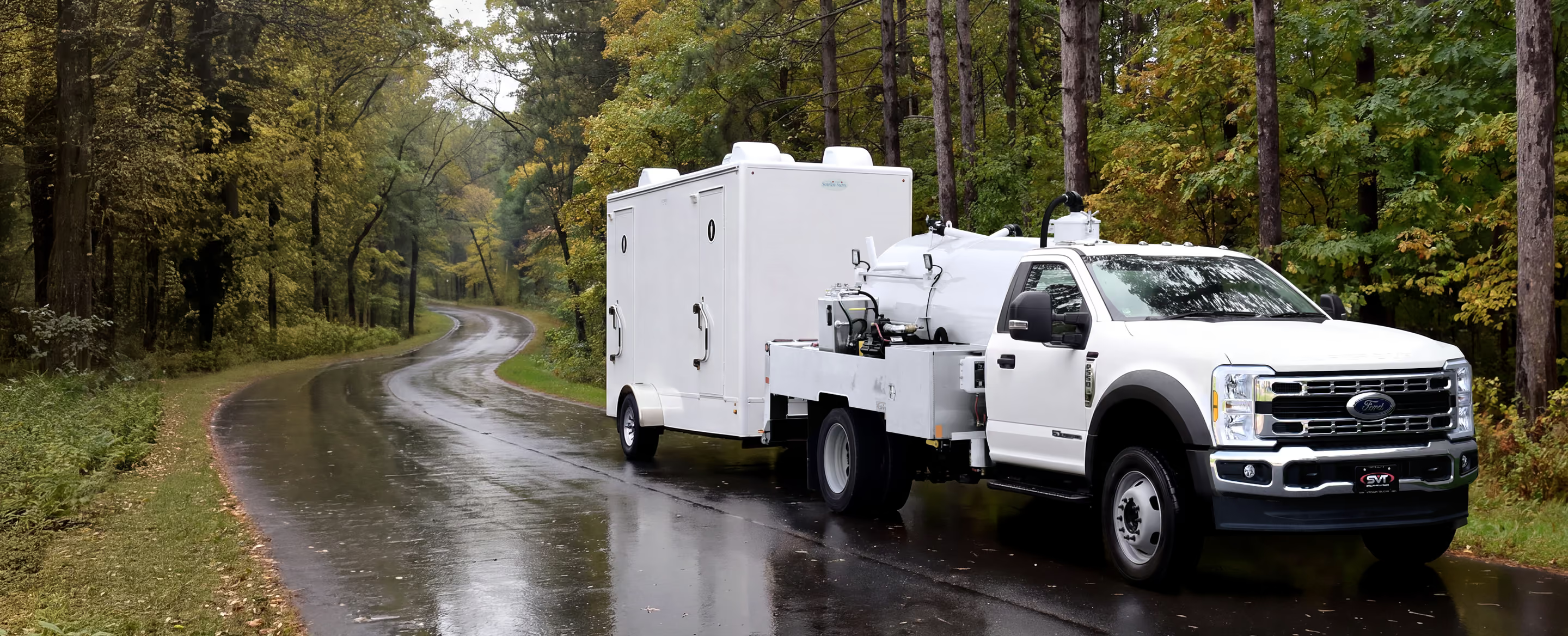
Purchasing used restroom trailers or shower trailers requires a more extensive inspection than evaluating a standard portable restroom.
Unlike a standalone plastic unit, a trailer combines a roadworthy chassis, an enclosed structure, and mechanical systems. Each introduces additional maintenance considerations and potential repair expenses.
Chassis, Axles, Tires, and Brakes
Begin with the trailer's structural components.
Inspect the frame for corrosion, especially around welds, suspension mounting points, and other high-stress areas. Check axle alignment and examine tires for uneven wear.
Tire tread alone doesn't indicate condition. Review the tire date codes to determine age, and inspect sidewalls for cracking or deterioration.
Brakes, lighting, and towing connections should also be evaluated before transporting the trailer.
A qualified trailer technician can help identify concerns that may not be visible during a basic inspection.
Plumbing and Freeze Damage
Improper winterization can allow water to freeze inside pipes, fittings, valves, and other plumbing components. As water expands, it can cause cracks that remain hidden until the system is pressurized.
Ask the seller how the trailer was winterized and whether maintenance records are available.
Whenever possible, operate the plumbing system to check for leaks, proper drainage, and consistent water flow.
Inspect connections around sinks, toilets, showers, and water storage components.
Water Heater, HVAC, and Electrical Systems
Mechanical and electrical systems should be tested under normal operating conditions.
Verify that the water heater operates correctly and that heating and cooling equipment functions as expected.
Inspect the shore power connection for visible damage or corrosion. Test lighting, outlets, and ground-fault circuit interrupter (GFCI) protection.
Electrical or mechanical deficiencies may require professional repairs, so obtain an assessment before finalizing the purchase.
Interior Finishes, Mold, and Water Intrusion
Water intrusion can cause extensive damage to a trailer's interior structure.
Inspect ceiling corners, wall seams, flooring, and areas beneath sinks or vanities.
Look for discoloration, soft flooring, damaged finishes, and musty odors. These conditions may indicate previous leaks or ongoing moisture problems.
Cosmetic improvements can make a trailer appear well maintained without addressing underlying damage.
Title, VIN, and Registration
Before purchasing, verify the trailer's vehicle identification number (VIN) and confirm that it matches the ownership documentation.
Check for outstanding liens and review applicable registration requirements.
Missing or inconsistent documentation can create complications when transferring ownership or placing the trailer into service.
For higher-value equipment, professional inspections and documentation verification are worthwhile steps.
Used Handwash Stations and Sinks
Used handwash stations can provide additional capacity for construction sites, outdoor events, and other locations requiring convenient handwashing facilities.
Start by testing the foot pump or other water delivery mechanism. Confirm that water flows consistently and that the pump returns to its resting position.
Inspect the basin for cracks and examine the fresh-water and gray-water tanks for leaks, staining, and persistent odors.
Check seals, fittings, drain connections, and any installed soap or towel dispensers.
Pumps and seals are typically serviceable components. A worn pump may be a relatively simple repair when compatible parts are available. A cracked or odor-saturated tank, however, may require replacement.
When comparing used equipment with new handwash stations, consider overall condition, sanitation requirements, and replacement-part availability.
Used Service Equipment
Portable sanitation businesses considering used equipment may also need to evaluate vacuum trucks and other servicing vehicles.
These purchases involve additional considerations, including engine condition, vacuum system performance, tank integrity, and maintenance history.
For a more detailed overview, review our used vacuum truck checklist before purchasing service equipment.
True Cost: Used Versus New
The initial purchase price is only one part of the overall investment in portable sanitation equipment.
A used restroom may cost less upfront, but refurbishment, maintenance, transportation, and unexpected downtime can reduce those savings.
Before purchasing, estimate the total cost of preparing the equipment for service.
Consider whether doors, hinges, tanks, or other components require replacement. Factor in cleaning, cosmetic improvements, and labor needed to bring the unit up to your operational standards.
Equipment downtime also has a financial impact. A unit requiring repeated repairs may be unavailable during periods of high customer demand.
For operators managing larger fleets, consistency can influence efficiency. Standardized equipment can simplify parts inventory, maintenance procedures, and employee training.
| Cost Consideration | Used Equipment | New Equipment |
|---|---|---|
| Purchase price | Lower upfront | Higher upfront |
| Refurbishment | May require immediate repairs | Typically no initial refurbishment |
| Maintenance | Depends on previous condition | Starts with new components |
| Downtime | Greater uncertainty | Generally more predictable initially |
| Remaining service life | Depends on age and exposure | Full expected service life |
| Warranty | Often unavailable | Manufacturer warranty |
| Resale value | Influenced by remaining condition | May retain greater value |
| Customer presentation | Varies with age and appearance | Consistent, professional appearance |
For additional purchasing considerations, explore our guide on how much a new porta potty costs.
The most useful comparison isn't simply what each unit costs today, but what it will cost to operate over its remaining service life.
A well-maintained used restroom may provide excellent value. However, when refurbishment expenses and potential downtime begin to outweigh the initial savings, new equipment may be the more practical investment.
When Buying New Makes More Sense
Used equipment has a place in many portable sanitation operations, but there are situations where purchasing new offers greater long-term value.
For businesses building a core fleet, new portable restrooms provide consistent appearance, current product features, and manufacturer support.
This consistency can be especially important for operators serving corporate events, high-visibility construction projects, and customers with specific equipment expectations.
New equipment also allows operators to select models based on their intended applications rather than adapting their operations to available used inventory.
Satellite Industries offers several portable restroom models designed for different operational needs.
The Tufway and Maxim 3000 are options for operators evaluating standard portable restroom equipment, while the Liberty ADA and Freedom provide accessible configurations for applications where accessibility is a priority.
When accessibility requirements apply, operators should verify that the specific equipment configuration meets applicable regulations and site requirements.
Another advantage of purchasing new is access to current replacement parts and manufacturer support. This can simplify maintenance planning and reduce uncertainty when components need to be replaced.
New equipment may also be worth considering when expanding into premium events or establishing a recognizable fleet appearance. Clean, consistent units can reinforce a company's professionalism and help create a positive customer experience.
Satellite Industries understands that every portable sanitation business has different priorities. The right purchasing decision depends on budget, customer expectations, equipment availability, and long-term growth plans.
For some operators, a combination of new and carefully selected used equipment may provide the best balance.
Frequently Asked Questions
Can I buy my own porta potty?
Yes. Commercial-grade portable restrooms can be purchased by businesses and individuals. Before buying, consider the intended application, required capacity, available servicing arrangements, and equipment specifications. Choosing a unit that meets your operational needs is more important than selecting the lowest purchase price.
How much is a used porta potty compared with a new one?
Used portable restrooms generally cost less upfront than new equipment. However, the difference depends on the unit's age, UV exposure, holding tank condition, replacement-part availability, and maintenance history. Equipment from a regularly serviced fleet may offer better value than a lower-priced unit with an unknown history.
How long does a portable restroom last?
A portable restroom's service life varies according to its materials, environmental exposure, maintenance, and handling. UV exposure is particularly important because prolonged sunlight can degrade polyethylene over time. Regular inspections and replacement of worn components can help extend usable life, but there is no single reliable lifespan for every unit.
What should I check before buying a used restroom trailer?
Inspect three primary areas: the chassis and towing components, plumbing systems for leaks or freeze damage, and ownership documentation. Also test electrical equipment, heating and cooling systems, and water heaters. Check interior finishes for moisture damage and verify the VIN and title before completing the purchase.
Is it worth buying used portable toilets to start a portable restroom business?
Yes. Used portable toilets can help new operators manage startup costs and test market demand before making larger equipment investments. However, buyers should carefully evaluate structural condition, parts availability, and appearance. Our guide to starting a portable restroom business covers additional equipment and planning considerations.
Build a Fleet That Supports Your Business
Whether you're purchasing used equipment to increase capacity or investing in new units for long-term growth, the goal is the same: dependable equipment that meets your customers' needs and supports efficient operations.
Taking the time to inspect equipment, evaluate ownership costs, and confirm parts availability can help you make a more informed purchasing decision.
Satellite Industries manufactures portable restrooms, trailers, and handwash stations designed for professional sanitation operations, with an emphasis on durability, serviceability, and long-term equipment support.
Explore our portable restroom lineup or contact the Satellite Industries team to discuss equipment options that fit your business.
Latest from the Satellite Industries Blog
Need Help {Finding the Right Sanitation Solution?}
Satellite Industries is the largest manufacturer of portable restrooms, restroom trailers, restroom trucks, septic trucks, slide-ins, unit haulers, vacuum technology, modular solutions, consumables and deodorizers.