From Curbside to Cleanup: Everything About Waste Collection Trucks
Why Waste Handling Trucks Are the Backbone of Modern Society
Waste handling truck systems are specialized vehicles designed to collect, transport, and manage waste, keeping communities clean and healthy. They range from automated side loaders for residential routes to vacuum trucks for liquid and hazardous materials.
Key Types of Waste Handling Trucks:
- Front Loaders – Handle commercial dumpsters up to 8,000 pounds and 40 cubic yards
- Side Loaders – Automated residential collection, can service up to 1,500 homes daily
- Rear Loaders – Traditional compacting trucks for mixed residential and commercial routes
- Roll-Off Trucks – Transport large containers (10-40 cubic yards) for construction debris
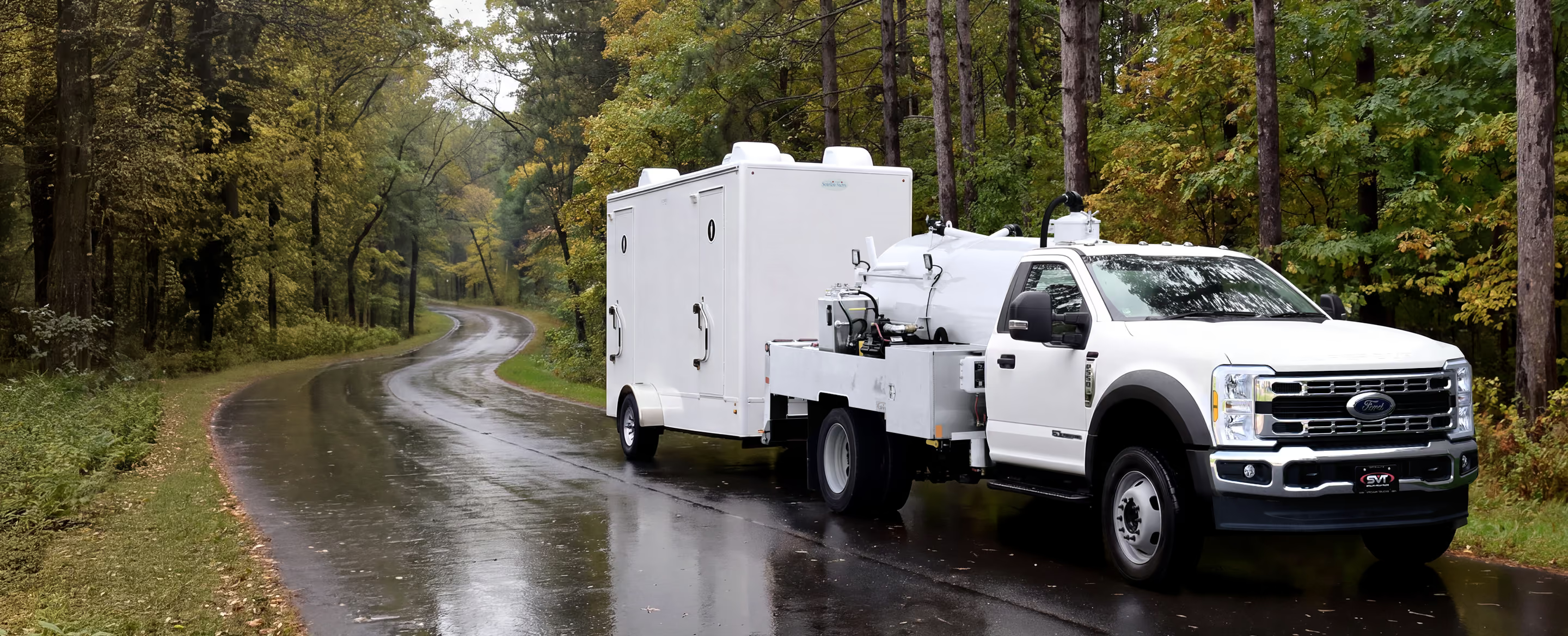
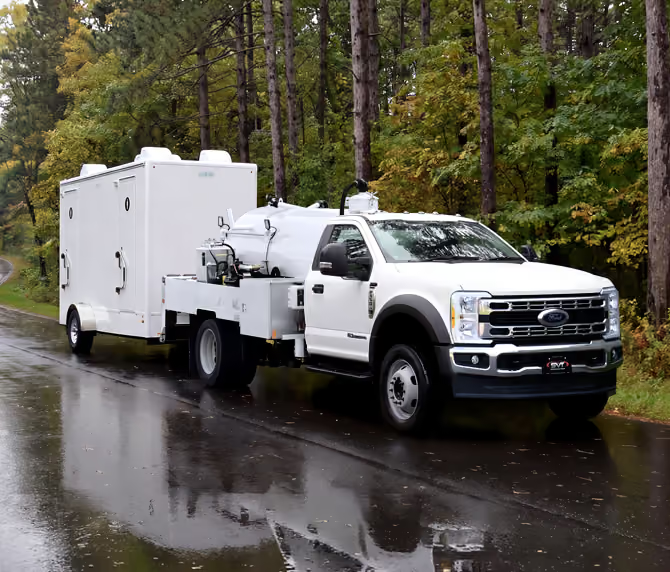
- Vacuum Trucks – Collect liquid waste, septic services, and hazardous materials
- Grapple Trucks – Handle bulky items like furniture and large appliances
The waste management industry generates $75.5 billion annually in the US, with the global market valued at $1.5 trillion in 2022. Modern trucks use advanced compaction, automated lifting, and alternative fuels to maximize efficiency and reduce environmental impact.
With over 26 years in portable sanitation, I’m Michelle Amelse, Vice President of Marketing and Customer Success at Satellite Industries. I’ve seen how waste handling truck technology impacts fleet operations and customer satisfaction. My experience in manufacturing and customer success provides deep insight into why these vehicles are essential for any sanitation business.

The Modern Waste Handling Truck: Types and Core Functions
The world of waste management relies on specialized equipment, and at its heart are waste handling truck systems. For distributors or renters of these vehicles, understanding their specific functions is key to building a versatile and efficient fleet. Let’s dig into the workhorses of the waste industry.
Front, Rear, and Side Loaders for Solid Waste
For municipal solid waste (MSW) collection, three primary waste handling truck models are used: front, rear, and side loaders. Each is engineered for different collection scenarios.
- Front Loaders: These are the giants of commercial waste collection. Their front-mounted hydraulic forks lift and empty large dumpsters (up to 8,000 lbs and 40 cubic yards). “Pack-on-the-go” hydraulics allow compaction while driving, speeding up routes for factories, malls, and industrial sites.
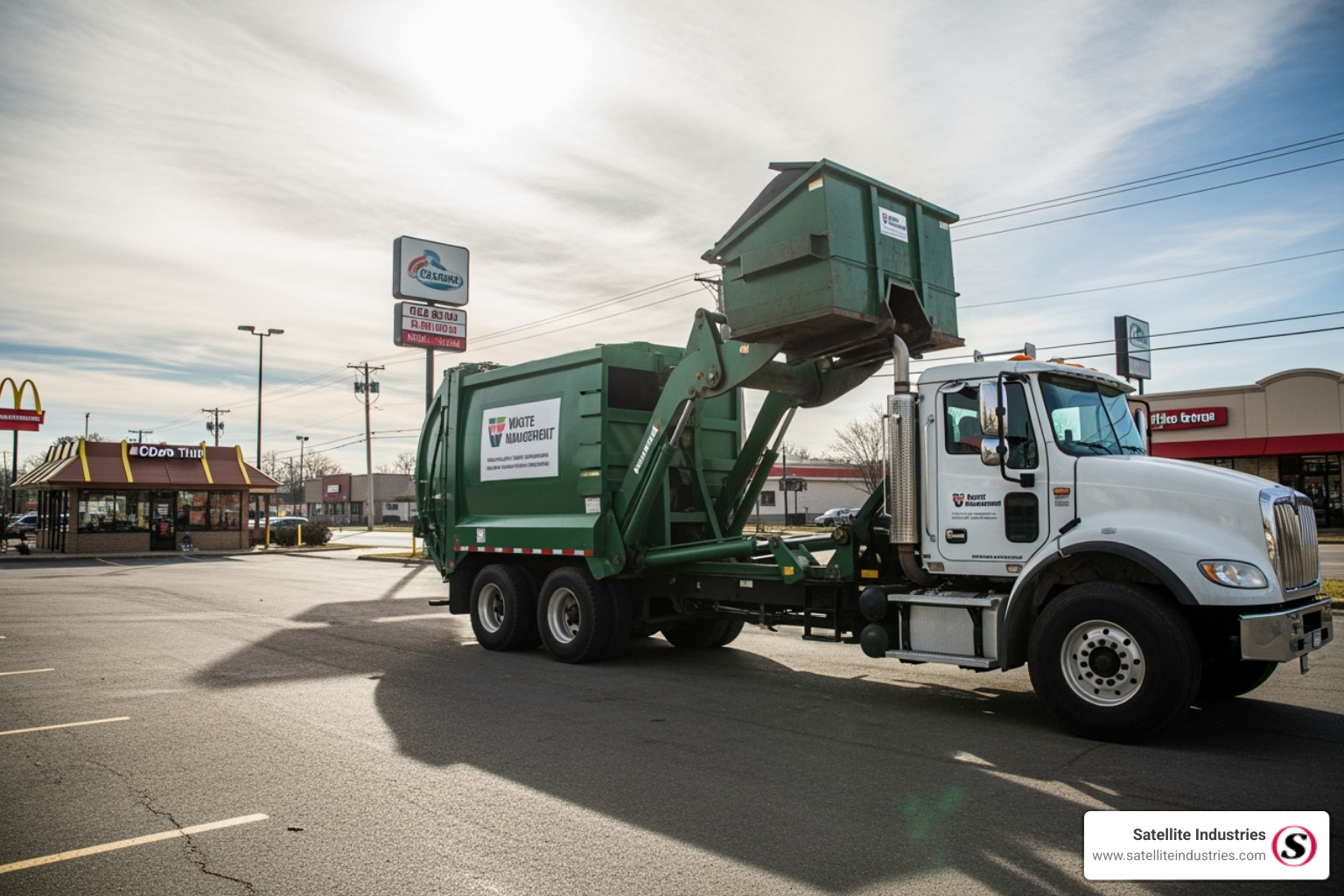
- Side Loaders: Side loaders, especially automated side loaders (ASLs), boost efficiency and safety on residential routes. A single operator uses an in-cab joystick to control a robotic arm, servicing up to 1,500 homes daily. This automation cuts labor costs and reduces injury risk. Their compact design is ideal for city streets, and some advanced models feature auger compactors for even greater efficiency.
- Rear Loaders: As the original compacting waste handling truck, rear loaders are versatile and widely used. Waste is loaded into a rear opening, and a hydraulic compactor sweeps it into the truck’s body. They are ideal for mixed residential and commercial routes, handling everything from bins to bulky items. Evolved designs like “sweep and slide” systems ensure efficient compression.
Specialized split-body recycling trucks have multiple compartments to collect different waste streams (like trash and recyclables) in one trip. This boosts resource recovery by enabling sorting at the source.
Roll-Off Trucks for Bulk Debris and Construction
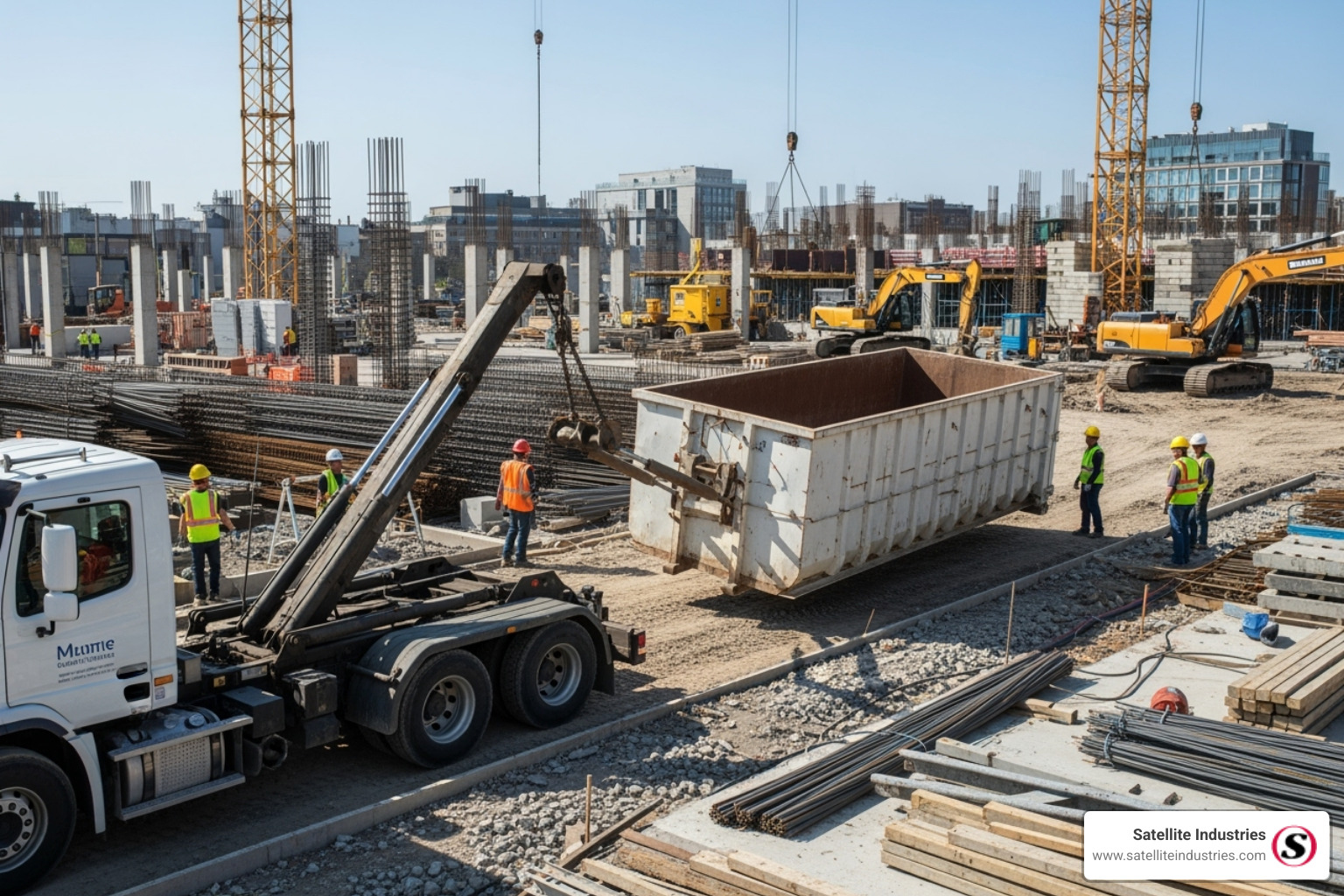
For large-scale waste removal in construction or industrial settings, the roll-off truck is essential. These robust vehicles transport massive open-top containers (10-40 cubic yards) for heavy, bulky materials that standard trucks cannot handle.
The primary function of a roll-off truck is to efficiently load, transport, and unload these large containers using one of two main systems:
- Cable Hoist Systems: A traditional, reliable method using cables and winches to pull containers onto the chassis.
- Hooklift Systems: A modern, faster alternative using a hydraulic hook arm to load and unload containers, often without the driver leaving the cab.
Roll-off trucks are indispensable for:
- Construction Debris: Hauling concrete, wood, drywall, and other construction waste.
- Large-Scale Cleanups: Managing waste from municipal cleanups or industrial facility clear-outs.
- Scrap Metal: Transporting heavy loads of scrap metal to recycling facilities.
- Bulky Waste: Collecting large items like furniture and appliances.
These trucks are a critical component for companies managing waste from job sites, ensuring that debris is removed safely and efficiently.
Specialized Vacuum Trucks for Liquid and Hazardous Waste
Liquid and hazardous waste management is critical for public health, and specialized vacuum trucks are the key. These vehicles are engineered to safely collect, transport, and dispose of non-solid materials, from sewage to industrial sludge.
At Satellite Industries, vacuum technology is a core manufacturing expertise. Our advanced engineering ensures our trucks are durable, user-friendly, and reliable in demanding environments.
Key functions and features of vacuum trucks include:
- Liquid Waste Collection: Their primary role is collecting liquid waste. This includes septic services and portable sanitation (servicing portable toilets and holding tanks). They use powerful pumps and durable storage tanks (e.g., 316 stainless steel) to safely contain liquids.
- Industrial Cleaning: Vacuum trucks are essential for industrial cleaning of sumps, pits, and tanks. “Combo units” with high-pressure water jetting can break up blockages and vacuum the debris, perfect for sewer cleaning.
- Hazardous Material Containment: For hazardous liquids, specialized vacuum trucks have improved safety and containment systems, including robust tanks and valves, to prevent spills and contamination during transport.
- Non-Destructive Digging (NDD): Also known as hydro excavation, NDD uses high-pressure water to break up soil and a vacuum to remove the slurry. This safely exposes underground utilities without the damage risk of mechanical digging, minimizing disruption.
- Tank Specifications: Our liquid waste handling truck models come in various capacities, from smaller 2,200-gallon units for tight access to larger semi-trailer tankers for high-volume industrial tasks. They feature robust pumps, durable tanks, and precise inlet/outlet valves to ensure efficient, safe operation.
The role these specialized trucks play in handling hazardous waste cannot be overstated. By safely containing and transporting dangerous substances, they prevent environmental disasters and safeguard public health. For distributors and rental companies, offering a range of these specialized vehicles, backed by our advanced engineering, means providing comprehensive solutions for every liquid waste challenge. Our presence in regions like Africa, the Americas, Australia, New Zealand, East Asia, South Asia, Europe, and the Middle East highlights the global demand for durable and user-friendly sanitation trucks.
Innovations Driving Efficiency and Sustainability
The waste management industry is constantly evolving to meet demands for efficiency, safety, and environmental responsibility. For providers of waste handling truck solutions, staying ahead of these innovations is crucial to making operations smarter, greener, and more sustainable.
The Role of Technology in a Modern Waste Handling Truck Fleet
Technology is a necessity in modern waste management. Trucks are now intelligent systems that improve everything from routes to maintenance.
- Onboard Computers and Tablets: These are the brains of the modern waste handling truck, providing drivers with real-time route information and customer details. This digital integration reduces paperwork, errors, and improves communication.
- Route Optimization Software: Advanced software creates the most efficient collection routes by analyzing data, traffic, and waste generation. This minimizes fuel use, travel time, and balances workloads, even optimizing for safety by reducing left-hand turns.
- GPS Tracking and Telematics: GPS provides real-time location data for fleet managers to monitor progress and route adherence. Telematics adds vehicle performance data (fuel use, driver behavior), which is invaluable for predictive maintenance and driver coaching.
- Data Collection and Fleet Management: The vast data collected enables data-driven decisions to optimize operations, manage assets, and improve profitability. Linked mobile apps offer a real-time view of the fleet.
- Driver Safety Systems: Safety technology is also key. Video-based safety systems record incidents for driver coaching. Programs like “Waste Watch” train operators to be community safety ambassadors by reporting suspicious activities.
By integrating these technologies, we provide intelligent solutions that empower customers to run their operations with unparalleled efficiency and safety.
The Shift to Alternative Fuels and Greener Operations
Environmental sustainability is driving a shift from diesel to cleaner alternatives in the waste handling truck industry. This transition benefits the environment, operational costs, and community relations.
- Compressed Natural Gas (CNG): CNG-powered trucks produce significantly fewer greenhouse gas emissions and particulate matter than diesel. Some major fleets report over one-third of their trucks run on natural gas.
- Renewable Natural Gas (RNG): RNG is a game-changer. It’s pipeline-quality gas produced from organic waste, often from landfills. Using RNG turns waste into fuel, creating a closed-loop system that reduces emissions and contributes to a circular economy.
- Electric Vehicle (EV) Technology: Fully-electric waste handling truck models are emerging, offering zero tailpipe emissions and quiet operation—a huge benefit for residential areas. While range and infrastructure are considerations, battery advancements are making EVs a viable option for urban routes.

The environmental benefits of using these alternative fuels are clear:
- Reduced Emissions: Less smog, fewer greenhouse gases, and cleaner air.
- Lower Fuel Costs: Natural gas and electricity can be more cost-effective than diesel.
- Quieter Operation: A major advantage for residential collection, reducing noise pollution.
By embracing greener technologies, our waste handling truck fleets contribute directly to environmental protection and public health.
Overcoming Industry Challenges with Advanced Engineering
The waste management industry is demanding. We provide waste handling truck solutions that overcome these challenges with advanced engineering for durability, safety, and user-friendliness.
Here’s how modern engineering provides solutions:
- Operator Safety: Manual waste collection is physically demanding and can lead to injury, as confirmed by research. Automated systems are the solution.
- Solution: Automated systems reduce manual labor, keeping workers safely inside the cab. Improved driver safety systems, including cameras and coaching programs, further protect operators.
FeatureManual CollectionAutomated CollectionWorker SafetyHigh risk of injury (lifting, traffic)Significantly reduced risk (in-cab operation)EfficiencySlower, requires multiple personnelFaster, often single-operatorCostHigher labor costsLower labor costs, potentially higher upfront truck cost - Scientific research on waste collector health
- Solution: Automated systems reduce manual labor, keeping workers safely inside the cab. Improved driver safety systems, including cameras and coaching programs, further protect operators.
- Durability and Reliability: Waste trucks operate in harsh, 24/7 environments, putting immense strain on components.
- Solution: Advanced engineering provides robust construction and high-strength materials. Key components are designed for maximum resilience, and features like factory-fitted automatic transmissions reduce wear. Our commitment to engineering ensures our trucks are built to last.
- Maintenance Costs and Uptime: Downtime is costly.
- Solution: Modern designs prioritize easy maintenance and longer service intervals. Telematics enables predictive maintenance by monitoring vehicle health, allowing for proactive repairs. Access to genuine parts and service programs maximizes uptime.
- Regulatory Compliance: The waste industry is heavily regulated.
- Solution: Our waste handling truck solutions are designed to meet or exceed regulatory standards. For example, some models are engineered with high compaction rates and light body weight to address DOT weight regulations without compromising capacity.
Our expertise at Satellite Industries in manufacturing trucks and advanced vacuum technology comes from understanding these challenges. We apply advanced engineering to ensure our products offer unparalleled durability and user-friendliness. We design for the real world, prioritizing robust performance, which helps our partners provide solutions that stand out.
As the global waste management market is projected to reach $2.1 trillion by 2030, demand for efficient, safe, and eco-friendly waste handling truck systems will intensify. By focusing on advanced design and technology, we are driving the industry’s future. For durable and user-friendly sanitation trucks that perform, explore our offerings, designed with decades of global experience.
Explore our durable and user-friendly sanitation trucks
Latest from the Satellite Industries Blog
Need Help {Finding the Right Sanitation Solution?}
Satellite Industries is the largest manufacturer of portable restrooms, restroom trailers, restroom trucks, septic trucks, slide-ins, unit haulers, vacuum technology, modular solutions, consumables and deodorizers.