Beyond the Basics: Exploring Temporary Sewer Tanks
Understanding Temporary Sewer Holding Tank Solutions
A temporary sewer holding tank is a sealed container designed to collect and store wastewater until it can be pumped and transported to an approved treatment facility. Unlike septic systems, these tanks provide no on-site treatment—they simply hold waste until removal, making them an essential solution when permanent sewer connections are unavailable.
Key Features of Temporary Sewer Holding Tanks:
- Capacity range: 250 to 13,200 gallons depending on application
- Materials: High-density polyethylene with UV inhibitors for durability
- Design: Seamless, low-profile construction with multiple connection ports
- Safety features: High-level alarm systems to prevent overflow
- Usage limit: Typically approved for commercial and temporary use up to 12 months
Common Applications:
- Construction site office trailers
- Special events (fairs, carnivals, festivals)
- RV parks and campgrounds
- Remote work locations without sewer access
- Emergency relief operations
- Seasonal or vacation properties
The tanks must be pumped regularly to prevent unsanitary conditions, with costs typically ranging from 10 to 30 cents per gallon plus service fees. Installation costs average about $1 per gallon of capacity for tanks up to 5,000 gallons.
I’m Michelle Amelse, Vice President of Marketing and Customer Success at Satellite Industries, with over 26 years of experience in the portable sanitation industry. My background in manufacturing and strategic account management has given me deep insight into what rental operators need from their equipment suppliers.

The Comprehensive Guide to the Temporary Sewer Holding Tank
When traditional sewer lines are not an option, a temporary sewer holding tank is a crucial piece of equipment for effective wastewater management. These tanks are designed to be robust, reliable, and temporary, serving as a vital link in the sanitation chain for a multitude of applications.
Core Functions and Common Applications
The primary function of a temporary sewer holding tank is to collect and safely store raw wastewater, including blackwater (from toilets) and greywater (from sinks and showers). It is a storage device only; unlike a septic system, it has no outlet and performs no on-site treatment. The tank’s sole purpose is to contain wastewater until it can be professionally removed by a septic pumper and transported to an approved disposal facility. This distinction is critical for regulatory compliance and environmental safety.
The versatility of these tanks makes them an indispensable solution across numerous scenarios:
- Construction Sites: Ideal for job site trailers and temporary offices lacking sewer hookups.
- Special Events: Provide sanitation for portable restrooms and mobile shower trailers at fairs, festivals, and concerts.
- Remote Work Camps: Offer a practical wastewater solution for mining, drilling, or industrial sites in isolated locations.
- Emergency Relief Efforts: Allow for rapid deployment of sanitation facilities for emergency camps and mobile medical units.
- Seasonal Properties: Manage wastewater at cottages, cabins, and RV parks where a full septic system is impractical.
- Renovation Projects: Bridge the gap when existing plumbing is out of service during major renovations.
Essentially, anywhere people gather without access to conventional sewer systems, a temporary sewer holding tank offers a reliable waste management solution.
Key Features and Sizing Your Temporary Sewer Holding Tank
Modern holding tanks are engineered for durability, efficiency, and ease of use. The most critical aspect is the material: high-density virgin polyethylene resin is standard due to its durability and impact resistance. This allows for seamless construction through rotational molding, creating a single, leak-proof unit. UV inhibitors are incorporated into the plastic to protect the tanks from sun degradation, ensuring a longer lifespan.
The physical design is optimized for practicality. Many tanks feature a low-profile, flat shape, making them ideal for placement beneath mobile structures like job site trailers. They are also equipped with multiple recessed ports to accommodate various plumbing configurations, allowing for quick and easy connections.

Choosing the right size is crucial. Sizing is based on the number of users, estimated wastewater generation, and planned pumping frequency. While specific regulations vary, a common best practice is to size the tank to hold at least five days of design flow or a minimum of 1,000 gallons, whichever is greater. Our products cater to a wide range of needs, with capacities from 250 gallons for small applications to over 13,000 gallons for major commercial sites.
A critical safety feature is a high-level alarm system. This system uses a float switch to trigger audible and visual alarms when the tank is nearing capacity, preventing costly and unsanitary overflows. This simple component helps operators schedule timely pump-outs and ensures smooth operations.
Installation, Setup, and Operational Best Practices
Proper installation is key to the efficient operation of a temporary sewer holding tank. First, the tank must be placed on level ground to ensure stability and must be located where service trucks have clear access for pumping.
Once positioned, plumbing is connected using rubber couplers and clamps, which provide a secure, leak-proof seal without specialized tools. Proper venting is also essential to prevent pressure imbalances and odor issues. The tank should be vented through the building’s sewer vent or a dedicated pipe. Finally, all lids and access ports must be securely fastened to prevent spills and contain gases. Following these best practices ensures every tank deployed operates at peak efficiency.

Navigating Regulations, Safety, and Environmental Impact
Operating a temporary sewer holding tank requires adherence to regulations to ensure safety and protect the environment. Most jurisdictions require permits from the local health department for installation and use. Always check with local authorities, as state and local regulations can vary significantly. For example, you can Learn about Florida’s holding tank regulations to see how specific they can be.
Key regulations often include pumping frequency rules (typically at least weekly) and usage duration limits (often a maximum of 12 months for temporary use). These rules ensure tanks are used as intended—as temporary, not permanent, solutions.
Safety is paramount. Never enter a holding tank due to the risk of asphyxiation from hazardous gases. Our tanks are built for spill prevention with a robust, leak-proof design, and high-level alarms add another layer of protection. The final step in environmental protection is ensuring wastewater is hauled by licensed pumping services to approved disposal facilities. This complete process safeguards public health and the environment.
Maintenance, Pumping, and Cost-Benefit Analysis
Effective maintenance for a temporary sewer holding tank is straightforward. Routine inspections for leaks or damage and regular alarm testing are essential. The most significant requirement is pumping by licensed services. For most temporary uses, pumping is required at least weekly. Establishing service contracts with reputable pumping companies ensures consistent service.
Costs associated with holding tanks include the initial purchase/rental, ongoing pumping fees (typically 10 to 30 cents per gallon plus service fees), and disposal costs, which are usually part of the pumping fee. Our commitment to advanced engineering ensures our tanks are built to last, maximizing your rental business ROI. While specific warranties can vary, the use of high-density polyethylene with UV inhibitors significantly extends the usable life of the tank in the field.
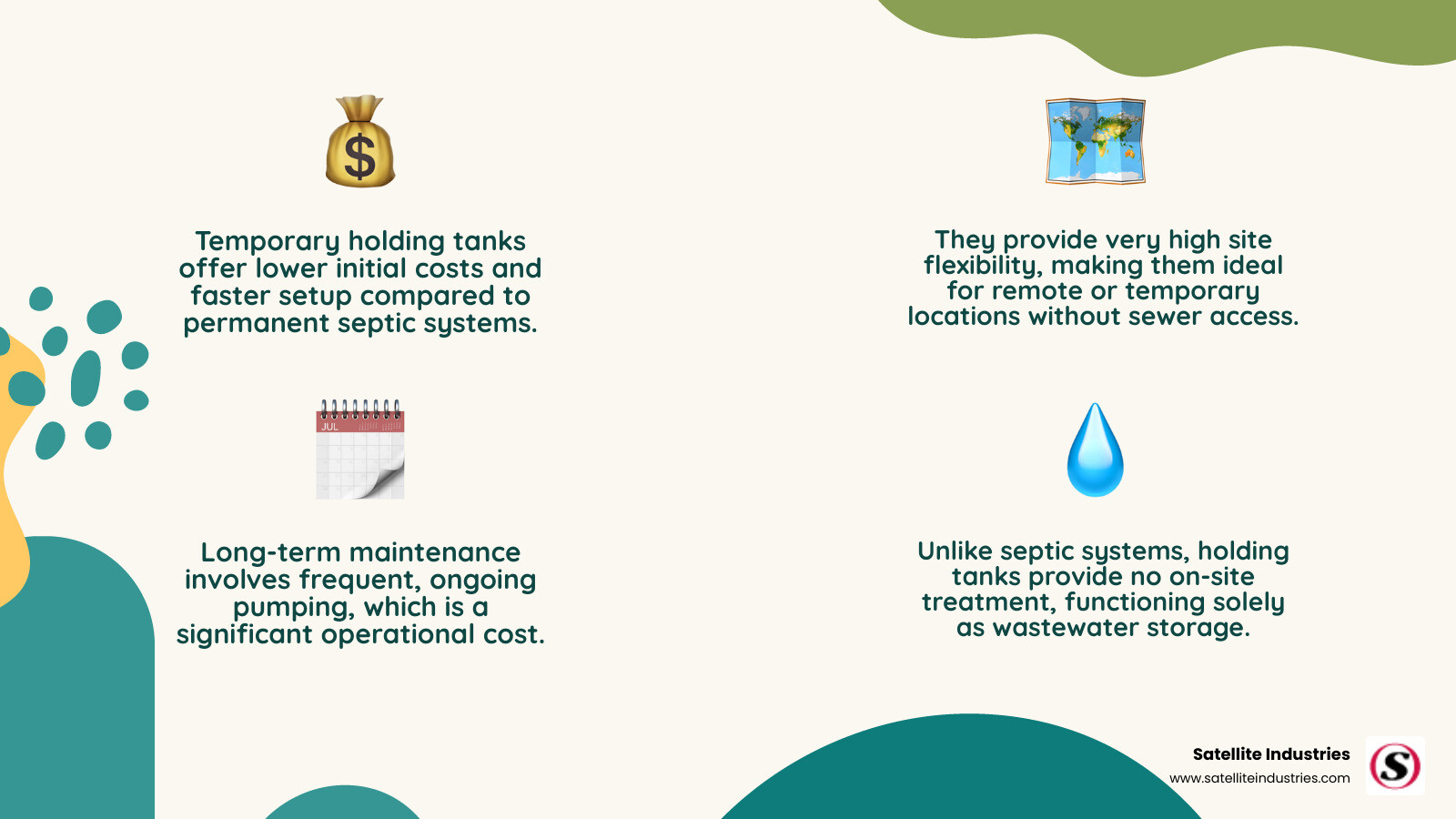
While ongoing pumping costs can be substantial, the advantages of a holding tank in terms of rapid deployment, site flexibility, and lower initial cost for temporary needs are clear.
Lift Your Fleet with Engineered Solutions
In the portable sanitation rental business, every piece of equipment matters. Your temporary sewer holding tank fleet is the foundation of your reputation and profitability. That’s why rental business ROI depends on choosing equipment that performs reliably, deployment after deployment.
At Satellite Industries, we are your manufacturing partner, creating the advanced solutions that power your business. We don’t rent equipment; we engineer it to help you succeed.
The importance of durability is clear in rental operations. Your tanks are transported to remote sites, connected and disconnected countless times, and exposed to harsh weather. A tank failure costs more than a replacement—it costs customer trust. Our commitment to advanced engineering means we use high-density virgin polyethylene with UV inhibitors and a seamless rotational molding process to eliminate weak points and prevent leaks. Every tank is built to withstand real-world challenges.
Beyond durability, user-friendly design for service is what separates good equipment from great. We design our holding tanks with your service technicians in mind. Multiple recessed ports simplify plumbing connections, and the low-profile design fits easily under trailers. When your crew can set up and service a temporary sewer holding tank quickly and confidently, you increase efficiency and customer satisfaction.
Satellite Industries has earned its reputation through decades of innovation and reliability. Our advanced engineering is the result of continuous improvement based on feedback from rental operators like you. We manufacture portable restrooms, trailers, trucks, and vacuum technology to the same exacting standards.
Ready to see how advanced engineering can transform your fleet’s performance and profitability? Explore our full range of portable sanitation solutions and find out why rental operators worldwide trust Satellite Industries to power their success.
Latest from the Satellite Industries Blog
Need Help {Finding the Right Sanitation Solution?}
Satellite Industries is the largest manufacturer of portable restrooms, restroom trailers, restroom trucks, septic trucks, slide-ins, unit haulers, vacuum technology, modular solutions, consumables and deodorizers.